
Nearly every American buyer and seller in Massachusetts faces the challenge of understanding why home values can swing so dramatically from one neighborhood to another. Local property prices are shaped by far more than just square footage or curb appeal. In fact, Boston’s median home price has topped $800,000, a striking reminder of how market conditions and neighborhood dynamics transform the real estate market. Learning what drives these shifts can help you make smarter decisions about your next move.
Table of Contents
- Defining Neighborhood Home Values In Massachusetts
- Major Factors Driving Local Property Prices
- How Exterior Improvements Impact Valuations
- Comparing Home Value Trends Across Towns
- Mistakes Homeowners Make In Valuing Homes
Key Takeaways
| Point | Details |
|---|---|
| Influential Neighborhood Factors | Key elements such as school quality, public transport access, and neighborhood safety significantly drive home values in Massachusetts. Understanding these factors can enhance property investment decisions. |
| Impact of Local Economic Trends | Property values fluctuate based on local economic dynamics, including infrastructure investments and job market strength. Staying informed on these trends is crucial for potential buyers and sellers. |
| Valuation Misconceptions | Homeowners often overestimate their property values due to emotional biases and a lack of market awareness. Engaging a certified appraiser can provide an objective valuation. |
| Exterior Improvements Matter | Strategic exterior upgrades can substantially increase property value. Homeowners should focus on improvements that enhance both aesthetic appeal and energy efficiency for the best returns. |
Defining Neighborhood Home Values in Massachusetts
Understanding home values in Massachusetts requires a nuanced look at multiple interconnected factors that shape residential real estate pricing. Unlike simplistic assessments, neighborhood home values emerge from a complex ecosystem of economic, social, and environmental dynamics that continuously evolve.
In Massachusetts, property valuations are fundamentally rooted in market conditions and comprehensive statistical analysis. Local assessments consider arm’s length sales transactions, which means evaluating real estate exchanges between willing buyers and sellers without external compulsion. These transactions provide critical data points that help municipal assessors determine fair market values, accounting for factors like property condition, location, recent improvements, and comparative neighborhood standards.
Moreover, Massachusetts neighborhoods experience unique valuation pressures from broader demographic and environmental shifts. The Healthy Neighborhoods Study reveals how community dynamics directly impact property pricing, highlighting that factors such as local infrastructure, school quality, economic development, and even climate resilience significantly influence home values. Urban centers like Boston demonstrate particularly complex valuation landscapes, where gentrification, technological innovation corridors, and community investment create rapidly changing residential ecosystems.
Critical factors affecting Massachusetts home values include proximity to employment centers, public transportation accessibility, school district performance, neighborhood safety ratings, and recent infrastructure investments. Local zoning regulations, historical preservation status, and emerging regional economic trends also play substantial roles in determining residential property worth.
Here’s a concise summary of the most influential factors affecting home values in Massachusetts neighborhoods:
| Influential Factor | Typical Impact on Value | Why It Matters |
|---|---|---|
| School District Quality | Higher value, more demand | Attracts families, boosts desirability |
| Public Transportation | Premiums for close access | Improves commuting, broadens demand |
| Neighborhood Safety | Increases market appeal | Buyers prioritize safe environments |
| Infrastructure Investment | Sustains or raises price levels | Signals community growth, adds amenities |
| Employment Proximity | Stronger appreciation potential | Easier access to major workplaces |
Pro Tip: Request a professional comparative market analysis from a local real estate appraiser to get the most accurate and current assessment of your specific neighborhood’s home values.
Major Factors Driving Local Property Prices
Local property prices in Massachusetts are driven by a sophisticated interplay of economic, geographic, and community-specific characteristics that create a dynamic and complex real estate landscape. Understanding these multifaceted influences helps homeowners, investors, and potential buyers comprehend the intricate mechanisms behind residential valuation.
Location remains the most fundamental driver of property values, with specific neighborhood attributes playing a critical role. Proximity to quality school districts, employment centers, and robust public transportation networks can significantly elevate residential pricing. Urban areas like Boston and Cambridge demonstrate how intellectual ecosystems, technological innovation corridors, and concentrated professional opportunities can create substantial property value premiums.

Economic indicators and local infrastructure investments also profoundly impact property pricing. Neighborhoods experiencing infrastructure upgrades, such as road improvements, utility modernizations, and community development projects, tend to see consistent property value appreciation. Municipal investments in parks, community centers, pedestrian infrastructure, and green spaces can transform residential perceptions and attract higher-income residents, thereby driving up local real estate values.
Additionally, external market factors like interest rates, regional economic health, demographic shifts, and housing supply dynamics create nuanced pressures on property pricing. Emerging trends such as remote work capabilities, changing generational preferences, and sustainability considerations are reshaping traditional valuation models. Older housing stock might see increased value through strategic renovations that improve energy efficiency, modernize living spaces, and align with contemporary residential expectations.
Pro Tip: Conduct a comprehensive neighborhood comparative analysis every two years to track emerging property value trends and understand the specific economic dynamics influencing your local real estate market.
How Exterior Improvements Impact Valuations
Exterior home improvements represent strategic investments that directly influence property values, transforming residential real estate from mere structures into marketable assets. Massachusetts homeowners can strategically leverage targeted exterior upgrades to significantly enhance their property’s financial potential and aesthetic appeal.
Investments in exterior features like energy-efficient windows and modern siding can substantially improve property appraisal values, offering dual benefits of enhanced visual attractiveness and measurable economic returns. Modern exterior upgrades communicate property maintenance, potential energy efficiency, and contemporary design sensibilities that resonate with potential buyers and professional appraisers alike. Strategic improvements such as replacement windows, updated siding, refreshed roofing, and enhanced landscaping can yield remarkable returns on investment.
Critical exterior improvements that consistently demonstrate strong valuation impact include replacement of aging exterior elements, implementing energy-efficient technologies, and creating visually appealing outdoor spaces. Potential high-return upgrades range from replacing worn siding with modern, low-maintenance materials to installing smart home exterior features like programmable landscape lighting, advanced security systems, and sustainable exterior design elements. These improvements not only increase immediate property aesthetics but also signal long-term value and potential to discerning buyers.
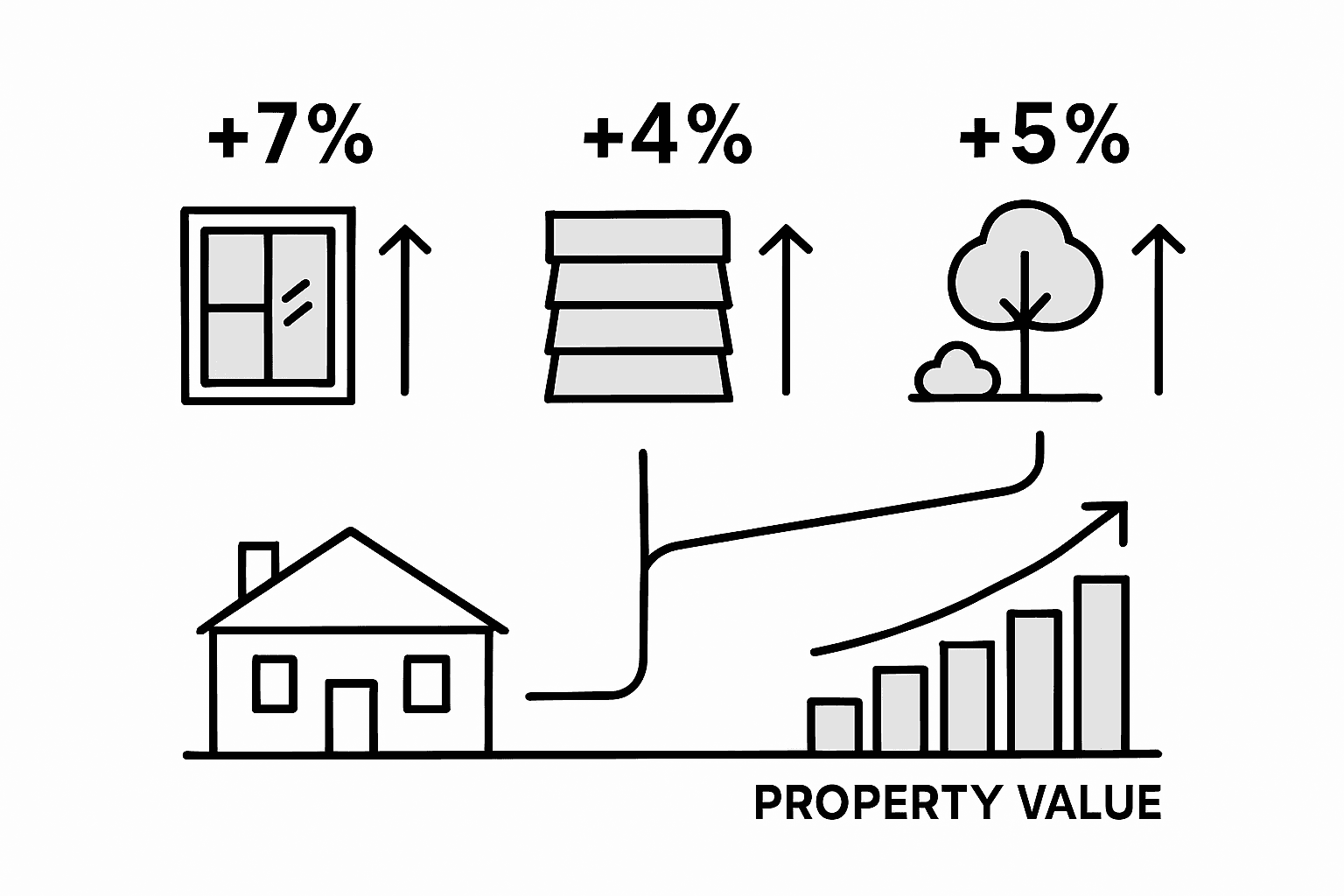
The financial impact of exterior improvements extends beyond immediate visual appeal, encompassing broader considerations of energy efficiency, maintenance costs, and overall property resilience. Homeowners should prioritize improvements that offer tangible functional benefits alongside aesthetic enhancements, focusing on upgrades that reduce long-term maintenance expenses and improve overall building performance. Comprehensive exterior renovations that balance visual appeal with practical functionality tend to generate the most substantial valuation increases.
To help guide exterior renovation decisions, here’s a comparison of high-impact home upgrades and their primary valuation benefits:
| Exterior Improvement | Boost to Value | Additional Benefits |
|---|---|---|
| Energy-Efficient Windows | Raises appraisal significantly | Lowers utility bills, modern aesthetics |
| Modern Siding Replacement | Notable return on investment | Improves curb appeal, reduces upkeep |
| Updated Roofing | Increases buyer confidence | Prevents water damage, extends lifespan |
| Enhanced Landscaping | Immediate visual impact | Creates usable outdoor living spaces |
| Smart Security Systems | Modest but growing appeal | Attracts tech-minded buyers |
Pro Tip: Consult a local real estate appraiser before making major exterior improvements to understand which specific upgrades will generate the highest return on investment for your specific neighborhood and property type.
Comparing Home Value Trends Across Towns
Massachusetts presents a complex and diverse residential real estate landscape, where home values fluctuate dramatically across different towns and regions. Understanding these nuanced variations requires a comprehensive examination of local economic, demographic, and infrastructure dynamics that shape property valuations.
Massachusetts towns exhibit remarkable variations in home value trends, with urban areas demonstrating steady appreciation driven by increasing demand, while suburban markets experience more variable pricing based on location desirability and community infrastructure. For instance, college towns like Amherst have seen extraordinary price acceleration, with home values jumping 21.58% above historical norms and reaching a median of $536,675, illustrating the significant impact of specialized local economic ecosystems on residential property valuations.
Urban centers such as Boston, Cambridge, and Worcester demonstrate distinctly different valuation patterns compared to more rural or suburban Massachusetts communities. These metropolitan areas benefit from concentrated economic opportunities, robust technological innovation corridors, and substantial infrastructure investments that consistently drive property values upward. Conversely, smaller towns experience more nuanced valuation dynamics, with factors like school district quality, proximity to major employment centers, and local economic development playing crucial roles in determining residential pricing.
Regional variations in Massachusetts home values reflect broader economic transformations, including shifts in remote work capabilities, generational housing preferences, and emerging sustainable development trends. Towns near major universities, technology hubs, and healthcare centers tend to maintain more stable and appreciating property values, while more isolated communities might experience more moderate or cyclical pricing patterns. The interplay between local amenities, job market strength, transportation infrastructure, and community development significantly influences these complex valuation trends.
Pro Tip: Conduct comprehensive comparative market analyses for multiple Massachusetts towns before making real estate investment decisions, focusing on long-term economic indicators and emerging community development trends.
Mistakes Homeowners Make in Valuing Homes
Home valuation represents a complex process that requires objective analysis, strategic thinking, and comprehensive market understanding. Massachusetts homeowners frequently encounter significant challenges when attempting to accurately assess their property’s true market value, often falling prey to common misconceptions and emotional biases.
Homeowners consistently overestimate their property’s value by failing to consider critical local market conditions and recent comparable sales, which can lead to unrealistic pricing strategies and extended market listings. This fundamental miscalculation stems from emotional attachment and a tendency to overvalue personal improvements without understanding broader market dynamics. Many homeowners mistakenly believe that every renovation or upgrade automatically translates into a dollar-for-dollar increase in property value, when in reality, market perception and neighborhood standards play far more substantial roles in determining actual property worth.
Additional valuation mistakes include relying exclusively on online estimation tools, neglecting the impact of broader economic trends, and failing to account for neighborhood-specific factors that influence pricing. Homeowners often underestimate the significance of location-based variables such as school district quality, proximity to amenities, local infrastructure developments, and emerging community trends. These nuanced elements can dramatically impact property valuation beyond simple square footage or recent renovation investments.
Professional real estate appraisers emphasize the importance of comprehensive, objective assessment methodologies. Emotional attachment, personal memories, and subjective perceptions of home improvements can significantly distort a homeowner’s understanding of true market value. Successful property valuation requires a disciplined approach that combines comparative market analysis, understanding of local economic trends, and an unbiased assessment of the property’s actual market positioning.
Pro Tip: Engage a certified local real estate appraiser who specializes in your specific neighborhood to obtain an objective, professional valuation that accounts for nuanced market dynamics.
Boost Your Massachusetts Home Value with Expert Exterior Improvements
Understanding how neighborhood factors like school districts, safety, and infrastructure impact Massachusetts home values is crucial. But one challenge many homeowners face is identifying the right exterior upgrades that truly increase property worth without overspending. The article highlights how strategic exterior improvements such as energy-efficient windows, modern siding, and updated roofing can dramatically enhance appraisal values and curb appeal. At Sabatalo Contracting & Home Improvement, we specialize in transforming your home’s exterior with over 15 years of trusted local expertise, ensuring your investment drives maximum value within your specific Massachusetts neighborhood.
Our professional team focuses on quality craftsmanship and durable materials to elevate your home’s protection, aesthetics, and energy efficiency. Whether you need windows installation, roof replacement, or complete siding upgrades, we tailor solutions based on your property’s unique context and market demands. Don’t leave your home valuation to chance when expert exterior improvements can set your property apart.
Ready to enhance your home’s market appeal and increase its value with trusted professionals in Massachusetts?

Take the first step today by visiting Sabatalo Contracting & Home Improvement to request a quote or consultation. Act now to turn your exterior improvements into long-lasting value and peace of mind.
Frequently Asked Questions
What factors influence home values in neighborhoods?
Home values in neighborhoods are influenced by factors such as proximity to quality school districts, public transportation access, neighborhood safety, recent infrastructure investments, and economic development.
How do exterior improvements affect property values in Massachusetts?
Exterior improvements like energy-efficient windows, modern siding, and landscaping can significantly increase property values by enhancing visual appeal and indicating good maintenance, which is attractive to buyers and appraisers.
Why is location important in determining home values?
Location is crucial as it impacts accessibility to employment centers, quality schools, and public amenities, all of which can elevate residential pricing and demand within a neighborhood.
How can homeowners avoid common mistakes in valuing their homes?
Homeowners can avoid valuation mistakes by consulting certified real estate appraisers, conducting thorough market research, and remaining objective, rather than letting emotional attachments distort their perception of property worth.
Recommended
- Benefits of Energy Audits for Massachusetts Homes | Sabatalo Contracting
- Annual Roof Inspections in Massachusetts: A 2025 Guide for Homeowners | Sabatalo Contracting
- Roof Replacement Process for Massachusetts Homeowners 2025 | Sabatalo Contracting
- When to Replace Windows: Guide for Massachusetts Homes 2025
- Interior Design and Property Value: Complete Guide
- 7 Types of Residential Renovations Every Homeowner Should Know
