TL;DR:
- Your front and security doors serve as the primary barrier protecting your family from outside threats. Proper compliance, material choice, hardware quality, and ongoing maintenance are essential for effective long-term security. Layering strong doors with reinforced glass, quality locks, and secondary barriers provides the best protection against forced entry.
Your front door and security door setup is the first real barrier between your family and the outside world. Most homeowners assume a solid door and a deadbolt are enough, but the reality is more complicated. Massachusetts building codes, material choices, locking hardware, and secondary barriers all work together, and gaps in any one area can undermine everything else. This guide walks you through what actually matters: code compliance, material selection, hardware, security screen doors, and ongoing maintenance so you can make decisions that hold up over time.
Table of Contents
- Key takeaways
- Massachusetts code requirements for front and security doors
- Choosing materials for secure front entrances
- Locks, hinges, and door hardware essentials
- Security screen doors and multipoint locking systems
- Keeping your doors secure over time
- My take on getting this right in Massachusetts
- How Sabatalocontracting can help you upgrade your entry
- FAQ
Key takeaways
| Point | Details |
|---|---|
| Code compliance comes first | IRC R311.2 sets clear size and swing requirements that shape every door and security upgrade you install. |
| Materials determine baseline security | Steel and fiberglass outperform wood for forced-entry resistance and long-term durability. |
| Layered security works best | Combining strong doors, quality locks, reinforced hinges, and security screens creates far better protection than any single upgrade. |
| Glass panels need attention | Laminated or tempered glass near locks is a commonly overlooked vulnerability that significantly affects security. |
| Maintenance preserves your investment | Regular checks on frames, seals, locks, and hinges keep your security setup performing as intended year after year. |
Massachusetts code requirements for front and security doors
Before you pick a style or compare prices, you need to understand what Massachusetts law actually requires. The state follows the International Residential Code, and IRC R311.2 mandates at least one side-hinged exterior egress door per dwelling. That door must provide a minimum clear width of 32 inches and a minimum clear height of 78 inches, measured with the door open 90 degrees between the face of the door and the stop.
That last detail trips up more homeowners than you might expect. The measurement is not the door width listed on the product spec sheet. It is the usable clear opening when the door is fully open. Some thicker door frames and certain security door configurations can reduce that measurement enough to fail inspection.
A few specific compliance pitfalls to know before you start shopping:
- Double-keyed deadbolts require a key to exit from the inside. They trap occupants during emergencies and fail code on any required egress door. Single-cylinder deadbolts with a thumb-turn on the interior side are the compliant choice.
- Door swing obstructions are a real concern when adding a security screen door or storm door. An improperly installed security door can block the required swing of the primary door and create an egress violation.
- Threshold height matters too. Raised thresholds on security door installations can create tripping hazards and accessibility issues that affect compliance.
Pro Tip: Before purchasing any front entry security door or screen door, take your actual clear opening measurements and bring them to a contractor or inspector for a quick review. Catching a sizing issue before installation saves far more time and money than fixing it after.
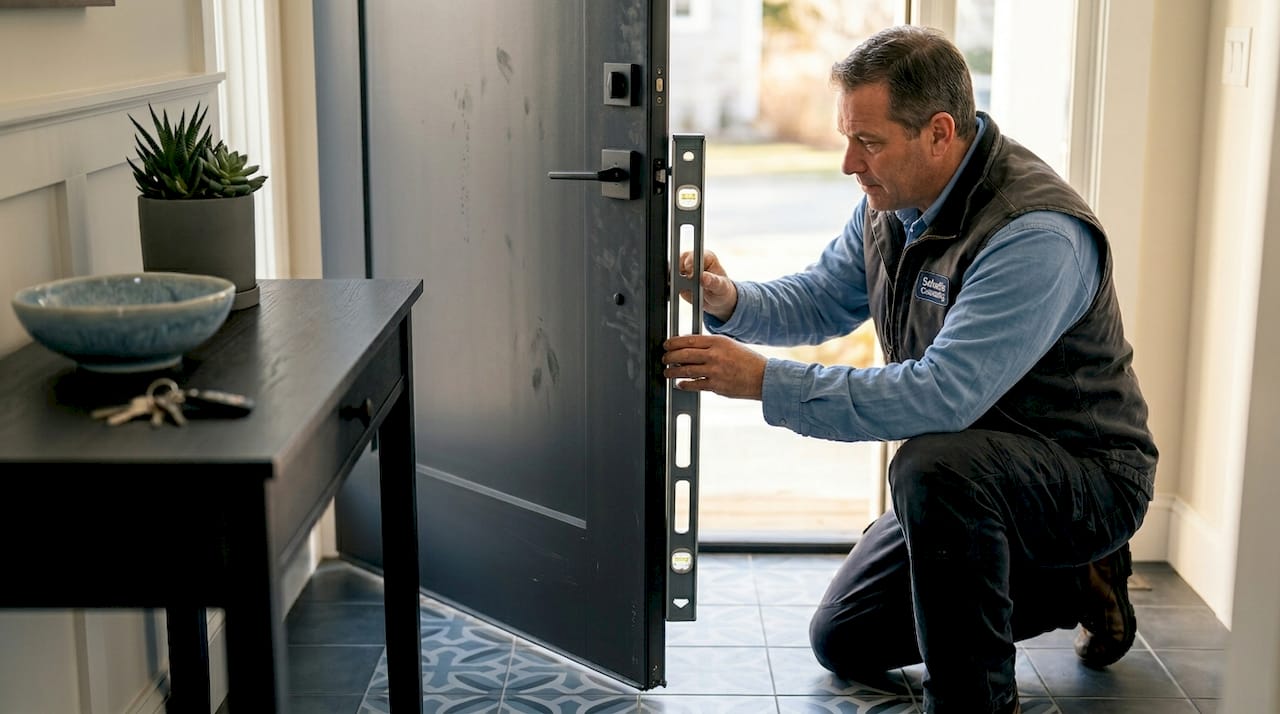
Massachusetts codes protect occupant safety over convenience, which makes pre-installation planning non-negotiable. A quick consultation with a local contractor who knows the state’s requirements is worth every minute. You can find solid guidance in this door installation tips resource from Sabatalocontracting.
Choosing materials for secure front entrances
The material your door is made from sets the floor for everything else. No lock or hinge upgrade can fully compensate for a weak door panel.
Steel, fiberglass, and solid wood compared
| Material | Security rating | Durability in MA climate | Maintenance level | Typical cost range |
|---|---|---|---|---|
| Steel | Highest | Excellent | Low to medium | $300 to $2,000+ |
| Fiberglass | High | Excellent | Low | $500 to $3,500+ |
| Solid wood | Moderate | Moderate (warps) | High | $500 to $5,000+ |
Steel doors are the strongest choice against forced entry. They resist kicks and impacts far better than wood, and modern steel doors include foam cores that add meaningful insulation. The tradeoff is susceptibility to dents and surface rust if the finish is damaged, which matters more in coastal Massachusetts towns like Gloucester or Plymouth.
Fiberglass doors offer a strong middle ground. They do not rust or warp, hold up well through harsh New England winters, and can be made to look like wood grain if aesthetics are a priority. For most Massachusetts homeowners, fiberglass is the practical choice when balancing security, appearance, and maintenance.
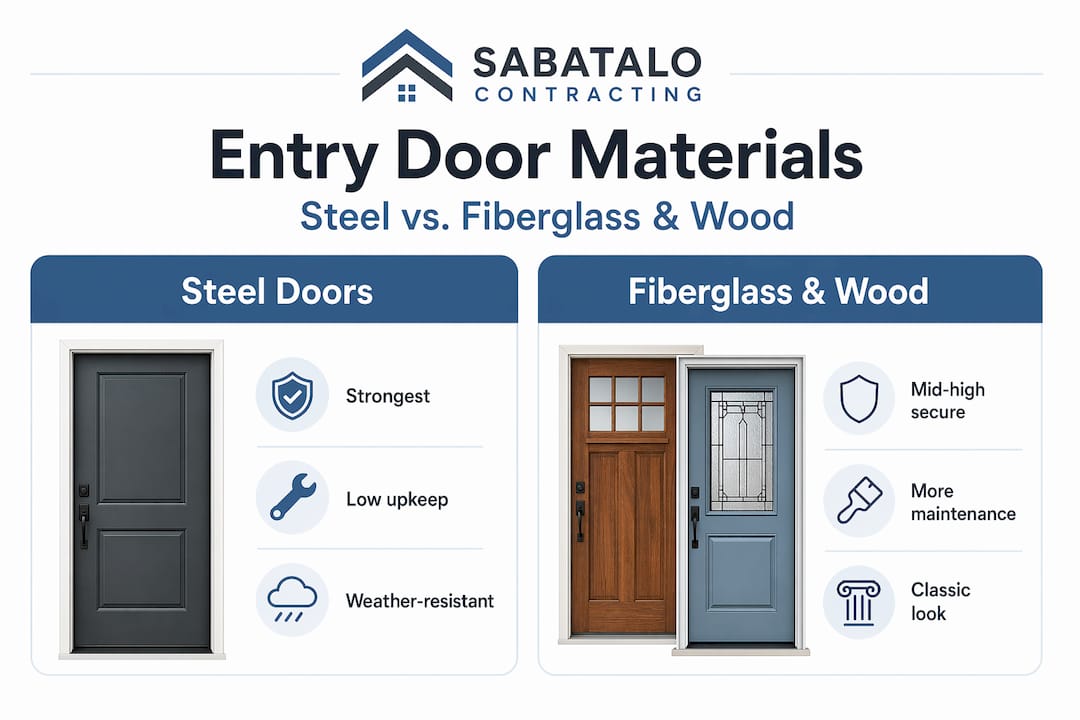
Solid wood doors have curb appeal but present real security limitations. They can swell, warp, and shift through New England’s freeze-thaw cycles, creating gaps that compromise both weather sealing and lock alignment.
Glass panels and security screens
Glass panels near locks or sidelights next to the door frame are among the most overlooked attack points in any entry setup. Laminated or tempered glass near lock hardware dramatically reduces the risk of someone breaking through to reach the lock mechanism. Security film applied to existing glass is a lower-cost alternative that meaningfully slows forced entry.
When choosing between a front door security screen door and a standard storm door, security screens win on protection. Storm doors are designed for weather control. Security screen doors are built with steel or aluminum frames and tamper-resistant hardware specifically to resist forced entry. They are not the same product, and treating them as interchangeable is a common and costly mistake.
Custom high-security exterior security door systems can run from $9,000 to $25,000, which puts them out of reach for most budgets. Adding a quality security screen door in the $1,000 to $1,500 range alongside a solid steel or fiberglass primary door gives most homeowners comparable layered protection at a fraction of the cost.
Locks, hinges, and door hardware essentials
The strongest door in the world fails if the hardware around it is weak. Hinges and strike plates are statistically the most common failure points in forced-entry scenarios. A kick near the strike plate, not the lock itself, is how most doors get forced open.
Here is what to prioritize when selecting and upgrading hardware:
- Choose ANSI/BHMA Grade 1 deadbolts. This is the highest residential rating for locks. Grade 1 hardware is tested for millions of cycles and withstands far greater force than lower-rated alternatives. Smart door locks rated to this standard add remote access and alert features without sacrificing security.
- Replace standard strike plates with reinforced models. A standard strike plate uses half-inch screws into soft door casing. A reinforced strike plate uses three-inch screws driven into the structural framing behind the casing, which is the difference between a door holding and a door giving way.
- Upgrade to security hinges with non-removable pins. Standard hinges on outward-swinging doors expose the hinge pin. Security hinges include set screws or non-removable pins that prevent someone from simply popping the door off its frame.
- Add a door reinforcer plate around the deadbolt and knob area. This steel wrap prevents the frame from splitting under impact, which is what happens when the strike plate stays intact but the surrounding wood fails.
- Consider a door security bar or floor brace. These inexpensive additions are particularly effective for supplementary protection on patio or side entry doors that may not be part of a full exterior security door upgrade.
Pro Tip: When installing smart locks, do not skip the physical backup deadbolt. Smart locks offer excellent convenience, but battery failures and software issues happen. A Grade 1 deadbolt installed alongside a smart lock covers both scenarios without compromise.
You can explore specific residential security devices for Massachusetts homes to match hardware to your specific door setup and local conditions.
Security screen doors and multipoint locking systems
A security screen door is not just a nice addition to your entry. When treated as part of the overall system, it functions as a genuine secondary barrier that forces any would-be intruder to defeat two independent layers rather than one.
Quality front entrance security doors in screen format share several features that set them apart from standard screen or storm doors:
- Steel or heavy gauge aluminum frames that resist bending and prying
- Stainless steel mesh that provides airflow and visibility without sacrificing structural strength
- Multipoint locking systems that engage at three or more points along the door frame simultaneously, which is far harder to force than a single-point lock
Multipoint locking systems that secure at the top, center, and bottom of the frame distribute impact across the entire door, not just one lock location. This design makes a security screen door dramatically more resistant to kicking than a door with a single deadbolt position.
Some security screen door models also include manufacturer warranties that cover insurance deductibles for burglary, which is a concrete financial benefit worth factoring into your selection. The Larson Platinum Secure Screen Door, as one example, starts at approximately $1,358 and ships in two to three weeks, with a six-step DIY installation that most experienced homeowners can complete in an afternoon.
That said, DIY installation of front entry security doors comes with a real caveat. The door must align properly with your existing frame to function correctly and to pass any egress inspection. If your current frame is out of square (which is common in older Massachusetts homes) professional installation is the smarter call.
Keeping your doors secure over time
Selecting and installing the right front door and security door combination is only half the job. Doors require regular attention to stay effective, and most homeowners skip this until something visibly breaks.
A practical maintenance routine covers these areas:
- Inspect the door frame and threshold each spring and fall for cracks, rot, or gaps that compromise the seal and the structural integrity of the entry
- Lubricate hinges, deadbolts, and lock cylinders annually with a dry graphite lubricant or a manufacturer-recommended product to prevent binding and wear
- Check smart lock batteries every six months and replace them proactively rather than waiting for a low-battery alert that may not arrive at a convenient time. Smart locks require ongoing maintenance including software updates to stay secure against evolving vulnerabilities
- Confirm that your security screen or storm door does not impede the primary door’s egress swing after any settling, frame movement, or hardware adjustments
- Test outdoor lighting around the front entry. Motion-activated lighting around the porch, walkway, and door frame is a proven deterrent that also supports camera visibility on doorbell systems
- Examine glass panels and security film for chips, delamination, or peeling that reduces effectiveness
Small maintenance gaps compound over years. A slightly misaligned strike plate, a worn weather seal, or a sticky lock cylinder are each minor issues alone. Together, they reduce the real-world performance of even the best security front doors residential installation can provide.
My take on getting this right in Massachusetts
I have seen a lot of homeowners approach front door upgrades backwards. They fall in love with a door style or a smart lock feature and start from aesthetics, then try to reverse-engineer the compliance and security requirements after the fact. That process almost always costs more time and money than starting with code and working outward.
What I have found over the years is that glass panels are consistently the most overlooked vulnerability on Massachusetts homes. A homeowner puts in a Grade 1 deadbolt and a reinforced strike plate, then leaves a sidelight panel with standard annealed glass right next to the lock. The glass is the easier target. Upgraded glass near locks is a small investment that closes a gap most people do not even know is there.
The layered approach is also something I push hard. No single product makes a door truly secure. What actually deters forced entry is the combination of a solid core door, quality hardware, reinforced glass, and a secondary barrier like a security screen. Each layer adds time and effort for anyone trying to get through, and time is what actually protects you.
My honest advice: get a professional measurement before you buy anything. Older Massachusetts homes, especially those built before 1980, often have out-of-square frames and non-standard rough opening sizes. What looks like a straightforward swap can turn into a framing and trim job. Knowing that upfront changes your budget and your timeline in ways that matter.
— Andrew
How Sabatalocontracting can help you upgrade your entry
If this guide has clarified what your home actually needs, Sabatalocontracting is equipped to handle the details that make the difference between a door upgrade and a door upgrade that lasts. With over 15 years serving Massachusetts homeowners across dozens of towns, the team at Sabatalocontracting handles everything from code-compliant measurements to material selection, installation, and hardware fitting.

Whether you are replacing an aging primary door, adding front entry security doors, or upgrading the full entry system, the right contractor makes sure nothing gets missed. Explore the full range of exterior door services from Sabatalocontracting to get started with a consultation tailored to your home, your neighborhood, and your security goals.
FAQ
What is the minimum door size required in Massachusetts?
Massachusetts follows IRC R311.2, which requires at least one side-hinged egress door with a minimum clear width of 32 inches and a height of 78 inches, measured with the door fully open at 90 degrees.
What is the difference between a security door and a storm door?
A storm door is designed primarily for weather protection and energy efficiency. A security door uses reinforced steel or aluminum framing, tamper-resistant locks, and steel mesh specifically to resist forced entry, making the two products serve different purposes entirely.
Can I install a double-keyed deadbolt on my front door in Massachusetts?
No. Double-keyed deadbolts require a key to exit from the inside, which violates egress code on any required egress door. Use a single-cylinder deadbolt with a thumb-turn on the interior side.
How much does a quality security screen door cost?
A quality security screen door typically runs between $1,000 and $1,500 for residential models. High-end custom security front doors residential options can reach $9,000 to $25,000, making a screen door layered over a solid primary door the most practical approach for most budgets.
How often should I inspect my front door hardware?
Inspect hinges, deadbolts, strike plates, and weather seals at least twice per year, ideally each spring and fall. Check smart lock batteries every six months and replace them before a failure occurs.
Recommended
- Replace Doors in MA for Real Savings: 12–30% Less | Sabatalo Contracting
- Front Door Security Devices That Protect Massachusetts Homes | Sabatalo Contracting
- 7 Essential Door Installation Tips for Massachusetts Homeowners | Sabatalo Contracting
- Energy Efficient Front Doors: Maximizing Home Comfort | Sabatalo Contracting
