TL;DR:
- Quality Massachusetts decks require proper permits, frost footing, and skilled local contractors.
- Certifications, references, and detailed contracts are crucial when selecting a deck builder.
- Regular inspections and maintenance ensure deck safety and longevity in harsh New England conditions.
Picking the right deck builder in Massachusetts is one of the most important home improvement decisions you’ll make. A poorly built deck can fail inspections, create safety hazards, and cost thousands in repairs. But a well-built deck adds serious value: ROI ranges from 65 to 95%, with wood decks averaging a 94.9% return on investment. This guide walks you through everything you need to know, from understanding realistic costs and vetting contractors to navigating Massachusetts permits and keeping your deck in top shape for years to come. Avoid the most common mistakes homeowners make and get the outdoor space you actually want.
Table of Contents
- Understanding deck project costs and ROI in Massachusetts
- How to vet potential deck builders for quality and experience
- Massachusetts regulations and permits: What homeowners must know
- Ensuring ongoing deck safety and maintenance
- Why experience and specialization matter more than price
- Next steps: Connect with trusted Massachusetts deck contractors
- Frequently asked questions
Key Takeaways
| Point | Details |
|---|---|
| Get clear on costs | Deck prices are higher in Massachusetts due to labor and permits, so plan your budget accordingly. |
| Vet for quality | Professional certifications and solid references are more important than low bids for deck builders. |
| Permits are essential | Permits and local codes must be handled to avoid fines and ensure safety. |
| Inspect annually | Regular deck inspections save money and preserve your home’s value. |
| Choose specialists | Specialized Massachusetts deck builders deliver better results and long-term satisfaction. |
Understanding deck project costs and ROI in Massachusetts
Before you call a single contractor, you need to know what a deck actually costs in Massachusetts. Prices here run higher than the national average, and for good reason. Local labor rates, frost footing requirements, and permit fees all push the numbers up. Getting a realistic budget in mind early keeps you from being surprised or misled by low bids.
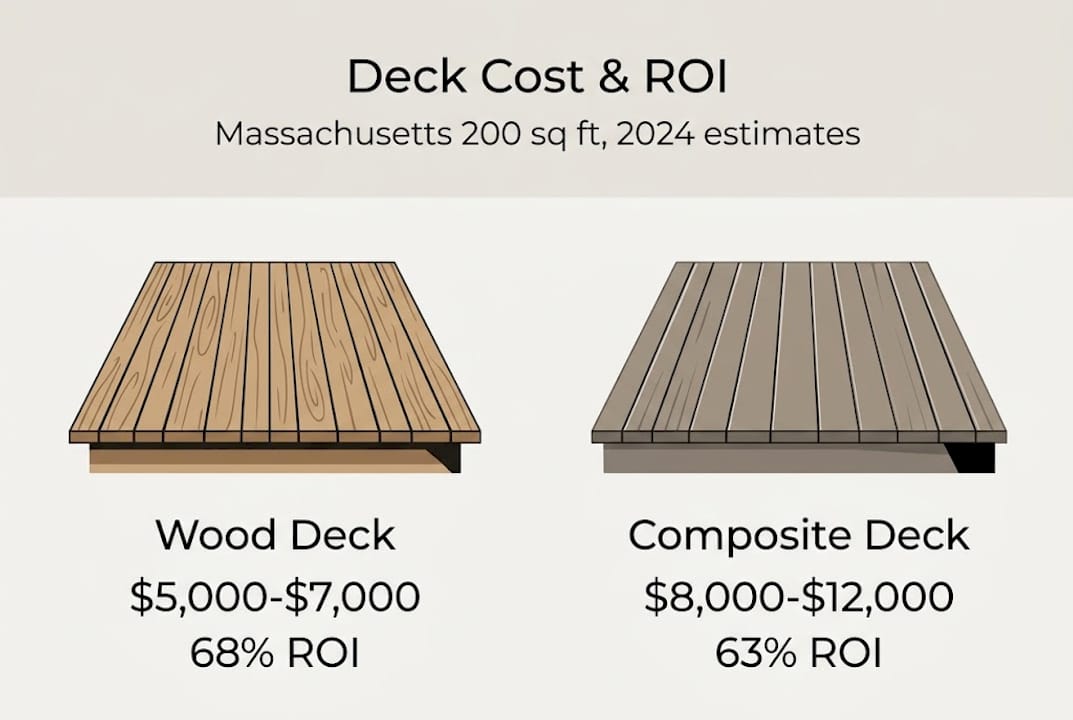
Deck installation runs $25 to $65 per square foot installed, with wood decks landing between $25 and $35 per square foot and composite decks ranging from $40 to $65. For a standard 200 sq ft deck, that puts your investment somewhere between $8,000 and $16,000 before Massachusetts-specific add-ons.
What drives costs higher in Massachusetts:
- Frost footings: Footings must extend below the frost line, typically 48 inches deep in most Massachusetts towns. This adds excavation and concrete costs that warmer-climate states simply don’t face.
- Permits: Expect to pay $100 to $400 depending on your municipality, and some towns require structural engineering sign-off.
- Labor: Skilled labor in the Boston metro and surrounding suburbs commands premium rates compared to rural areas.
- Material choices: Pressure-treated wood is the budget-friendly baseline, while composite decking like Trex or TimberTech adds durability but raises the upfront cost significantly.
| Material | Cost per sq ft | 200 sq ft estimate | ROI |
|---|---|---|---|
| Pressure-treated wood | $25–$35 | $5,000–$7,000 | 94.9% |
| Composite decking | $40–$65 | $8,000–$13,000 | 88.5% |
The ROI numbers are worth paying attention to. Wood decks return more at resale, but composite decks save money on long-term maintenance. In Massachusetts, where winters are brutal and moisture is constant, composite materials often pay for themselves over a 10 to 15 year window through reduced upkeep costs.
Working with experienced Massachusetts deck contractors who understand local pricing and material performance gives you an honest picture from the start. A contractor who can’t explain why their quote is what it is should raise a flag immediately.
How to vet potential deck builders for quality and experience
Once you know your budget, the next step is finding a contractor who deserves the job. This is where most homeowners make their biggest mistake: choosing based on price alone. The lowest bid almost never delivers the best outcome.
Low bids often signal inferior materials or labor, and NADRA-certified professionals consistently reduce the risks that come with hiring general contractors who dabble in deck work. NADRA stands for the North American Deck and Railing Association, and their certification means a contractor has demonstrated specific knowledge of deck construction standards.
What to look for when vetting a deck builder:
- Valid Massachusetts contractor license: Verify through the state’s Office of Consumer Affairs and Business Regulation.
- General liability and workers’ compensation insurance: Ask for certificates, not just verbal confirmation.
- NADRA certification or equivalent: Shows specialized knowledge beyond basic carpentry.
- Portfolio of local projects: Photos of decks built in Massachusetts towns, not stock images.
- Recent references: Talk to homeowners who had decks built in the last two years, not five.
- Written contract with material specs: Every board type, fastener grade, and finish should be documented.
| What to compare | Strong contractor | Red flag |
|---|---|---|
| Bid detail | Itemized with materials listed | Vague lump sum |
| Timeline | Realistic with milestones | “We’ll get it done fast” |
| Insurance | Certificates provided immediately | “Don’t worry, we’re covered” |
| References | Recent, local, verifiable | Old or out-of-state only |
| Permit handling | Pulls permits themselves | Asks you to pull them |
Pro Tip: Always ask for photos of a completed deck project in your town or a neighboring one. Massachusetts building codes vary by municipality, and a contractor familiar with your local inspector will save you time and headaches during the approval process.
“A deck is only as strong as the contractor who builds it. Credentials, references, and a detailed contract aren’t optional extras. They’re your protection.”
You should also check deck safety inspections as a baseline for understanding what a properly built deck looks like before you sign any contract. Knowing what inspectors look for helps you ask smarter questions during the bidding process. Homeowners who do this tend to make better decisions, and trusted Massachusetts remodelers will welcome those informed conversations.
Massachusetts regulations and permits: What homeowners must know
Massachusetts has specific building requirements that affect every deck project, and your contractor should be the one navigating them, not you. If a builder suggests skipping permits to save money or speed things up, walk away immediately. Unpermitted decks create serious problems at resale and can result in costly forced demolition.
Most Massachusetts towns require a building permit for any deck attached to the home or elevated more than 30 inches off the ground. The process typically involves submitting plans, paying the permit fee, and passing one or more inspections during construction. Permits range from $100 to $400 depending on your town, and some municipalities require a licensed engineer to stamp the drawings.
Key permit and code considerations in Massachusetts:
- Frost footings: Required to extend below the 48-inch frost line in most of the state.
- Ledger attachment: The connection between your deck and your home must meet specific load requirements and flashing standards.
- Railing height and spacing: Railings must be at least 36 inches high for decks under 30 inches, and 42 inches for higher decks, with balusters spaced no more than 4 inches apart.
- Roof decks: These face the strictest scrutiny. Boston roof decks require extra fire and egress rules beyond standard deck codes, including specific waterproofing, weight load calculations, and emergency exit provisions.
- Accessibility: If your home has accessibility requirements, your deck design must accommodate them.
“Skipping a permit doesn’t just risk a fine. It means your deck was never verified to be structurally safe. That’s a liability you carry every time someone stands on it.”
Your contractor should pull permits in their name, coordinate with the local building department, and schedule all required inspections. If they hand you a permit application and tell you to file it yourself, that’s a sign they’re not fully invested in the project. Reputable Massachusetts deck contractors handle this process as a standard part of the job.
For projects that involve roofing components or structural changes above the deck, it’s also worth reviewing Massachusetts roofing regulations to understand where deck and roof codes overlap.
Ensuring ongoing deck safety and maintenance
Building a great deck is only half the job. Keeping it safe and looking good over the long term requires consistent attention, especially in Massachusetts where freeze-thaw cycles, snow loads, and humidity put real stress on outdoor structures.
Annual inspections of aging decks can save 20 to 50% compared to full replacement if the framing is still structurally sound. Catching problems early is almost always cheaper than waiting until they become emergencies.
Annual deck inspection checklist:
- Check for rot: Probe wood members with a screwdriver. Soft spots mean moisture has penetrated and decay has started.
- Inspect fasteners: Look for popped nails, corroded screws, and loose bolts, especially at the ledger connection.
- Test railings: Apply lateral force to railings and posts. Any wobble needs immediate attention.
- Examine decking boards: Look for cracks, warping, or splinters that signal weathering or moisture damage.
- Check the ledger flashing: This is the most common source of water intrusion and structural failure.
- Look underneath: Inspect joists and beams for signs of pest damage, sagging, or cracking.
Pro Tip: In Massachusetts, the best time to do your annual inspection is in early spring, right after the snow melts. Winter conditions reveal problems that dry summer weather can hide, and catching them in spring gives you the full season to make repairs before the deck sees heavy use.
For specific repair guidance, the deck board repair guide covers common fixes in detail. Before winter hits, the deck winterizing guide walks you through protecting your investment against Massachusetts cold. And if you want a professional eye on your structure, deck safety inspection tips explain what certified inspectors look for and when to call one in.
Routine maintenance like cleaning, sealing, and re-staining wood decks every two to three years dramatically extends their lifespan. Composite decks require less upkeep but still benefit from annual cleaning and hardware checks.
Why experience and specialization matter more than price
Here’s the uncomfortable truth most homeowners don’t hear until it’s too late: a deck built by a generalist contractor who occasionally does deck work is not the same as one built by a specialist. The difference shows up in how the ledger is flashed, how the footings are sized, how the permit process is managed, and how the finished product holds up after three Massachusetts winters.
Price-first thinking almost always leads to a second, more expensive project down the road. We’ve seen it repeatedly. A homeowner saves $2,000 on a low bid, then spends $6,000 two years later fixing rot, failed footings, or code violations discovered at resale.
NADRA-certified professionals reduce the risk that comes with hiring someone who treats deck building as a side service. Specialists understand frost depth requirements, local inspector expectations, and which materials actually perform in New England conditions. That knowledge isn’t reflected in a price. It’s reflected in a deck that’s still solid 15 years from now.
Choosing Massachusetts deck specialists who focus specifically on outdoor structures isn’t just about getting a better product. It’s about protecting your investment, your family’s safety, and your home’s long-term value.
Next steps: Connect with trusted Massachusetts deck contractors
You now have a clear picture of what a quality deck project looks like from start to finish. The next move is connecting with professionals who can bring that picture to life for your specific home and budget.

At Sabatalo Contracting, we’ve spent over 15 years building decks across Massachusetts, handling permits, navigating local codes, and delivering outdoor spaces that hold up through every season. Our Massachusetts deck contractors team is ready to walk you through material options, realistic timelines, and honest pricing. If your project also involves exterior upgrades, our Massachusetts roofers and Massachusetts siding experts can coordinate everything under one roof. Reach out today to request your personalized quote and take the first step toward an outdoor space you’ll actually use.
Frequently asked questions
What should I look for in a deck builder beyond price?
Prioritize certifications like NADRA, valid insurance, a detailed written contract, and verifiable local references. NADRA-certified pros reduce risk compared to general contractors without specialized deck training.
Do I need a permit to build a deck in Massachusetts?
Yes, permits are required for most decks in Massachusetts and cost $100 to $400 depending on your town. Roof decks in cities like Boston require additional fire safety and egress approvals beyond standard permits.
How much does a deck cost in Massachusetts?
A 200 sq ft deck typically runs $8,000 to $16,000 depending on materials, with Massachusetts labor, frost footings, and permits pushing costs above the national average for both wood and composite options.
How often should decks be inspected for safety?
Annual inspections are strongly recommended, particularly for older decks or those exposed to harsh New England winters. Inspecting aging decks yearly can save 20 to 50% in repair costs by catching problems before they require full replacement.
Recommended
- Deck Safety Inspection Guide for Massachusetts Homeowners | Sabatalo Contracting
- Winterizing Your Deck for Maximum Protection and Longevity | Sabatalo Contracting
- Deck Contractors in Massachusetts | Sabatalo Contracting
- How to Repair Deck Boards for Safe, Attractive Outdoor Spaces | Sabatalo Contracting
