
TL;DR:
- Choosing efficient A rated windows can significantly lower Massachusetts home heating and cooling costs. Proper installation and meeting ENERGY STAR Northern Zone standards are essential for maximizing energy savings and durability. Reputable brands like Andersen and Pella, combined with thoughtful style choices and professional installation, ensure long-lasting comfort and curb appeal.
Choosing the right replacement windows feels straightforward until you realize how many rating systems, technical specs, and marketing claims are competing for your attention. A rated windows represent the upper tier of energy performance, but what that actually means for your heating bills, home comfort, and curb appeal depends on factors most window shoppers never think to ask about. This guide cuts through the noise and gives you exactly what you need to make a confident decision for your Massachusetts home.
Table of Contents
- Key takeaways
- What a rated windows actually mean
- Energy savings and what they cost
- Trusted brands for Massachusetts homes
- Aesthetic and design features worth knowing
- Installation and maintenance practices that protect your investment
- My honest take after years of window projects
- How Sabatalocontracting helps you get this right
- FAQ
Key takeaways
| Point | Details |
|---|---|
| A rated windows save real money | Upgrading to efficient windows can reduce annual heating and cooling costs by 7–15% in Massachusetts. |
| U-factor matters more than brand | A rated windows typically have U-values between 0.8 and 1.1 W/m²K, directly impacting heat loss. |
| Massachusetts has specific requirements | ENERGY STAR Northern Zone standards require a U-factor at or below 0.27 for maximum performance. |
| Installation quality is non-negotiable | Even the best-rated window loses its efficiency benefits if it’s installed incorrectly or without proper sealing. |
| Brand trust is backed by data | Andersen and Pella rank as the most trusted window brands in America for 2026, per consumer research. |
What a rated windows actually mean
Most homeowners assume “A rated” is a straightforward label, like a letter grade on a report card. The reality is a little more layered. Window energy ratings run on a scale from G (least efficient) to A++ (best), and where your window falls on that scale depends on two core measurements: U-factor and Solar Heat Gain Coefficient (SHGC).
The U-factor measures how much heat escapes through the window. Lower is better. A rated windows typically carry U-values between 0.8 and 1.1 W/m²K, which represents a significant improvement over standard double-pane windows. The SHGC tells you how much solar energy the window lets in. A lower SHGC keeps summer heat out, while a higher SHGC allows passive solar warming in winter.
Here is the breakdown of how the rating tiers compare:
| Rating | U-value range | Best suited for |
|---|---|---|
| A++ | Below 0.8 | Maximum insulation, very cold climates |
| A+ | 0.8–1.0 | Northern states, harsh winters |
| A | 1.0–1.1 | Most New England homes |
| B | 1.1–1.4 | Moderate climates |
| C and below | Above 1.4 | Not recommended for Massachusetts |
Massachusetts sits in ENERGY STAR’s Northern Climate Zone. That means the program sets strict targets: ENERGY STAR Northern Zone windows must have a U-factor at or below 0.27 and a SHGC at or below 0.40. Confusingly, this is a different scale from the A-to-G rating, which uses metric measurements. Your best approach is to look for windows that meet both the letter grade and the ENERGY STAR Northern Zone certification.
Pro Tip: When shopping for replacement windows, ask the dealer for the NFRC (National Fenestration Rating Council) label. It gives you standardized U-factor and SHGC data that lets you compare products side by side, regardless of which brand’s marketing you are reading.
Energy savings and what they cost
The most common homeowner question about high performance windows is simple: will I actually notice the savings? The short answer is yes. Upgrading to efficient double-pane windows can save Massachusetts homeowners between 7 and 15 percent on annual heating and cooling bills. For a home spending $3,000 a year on energy, that is $210 to $450 back in your pocket annually.
The upfront cost is the harder conversation. Here is what you can realistically expect for installed A rated windows:
- Vinyl frames: $450 to $900 per window installed, the most popular choice by far
- Wood frames: $800 to $1,500 per window, offering premium aesthetics with more upkeep
- Fiberglass frames: $900 to $1,800 per window, the highest durability option available
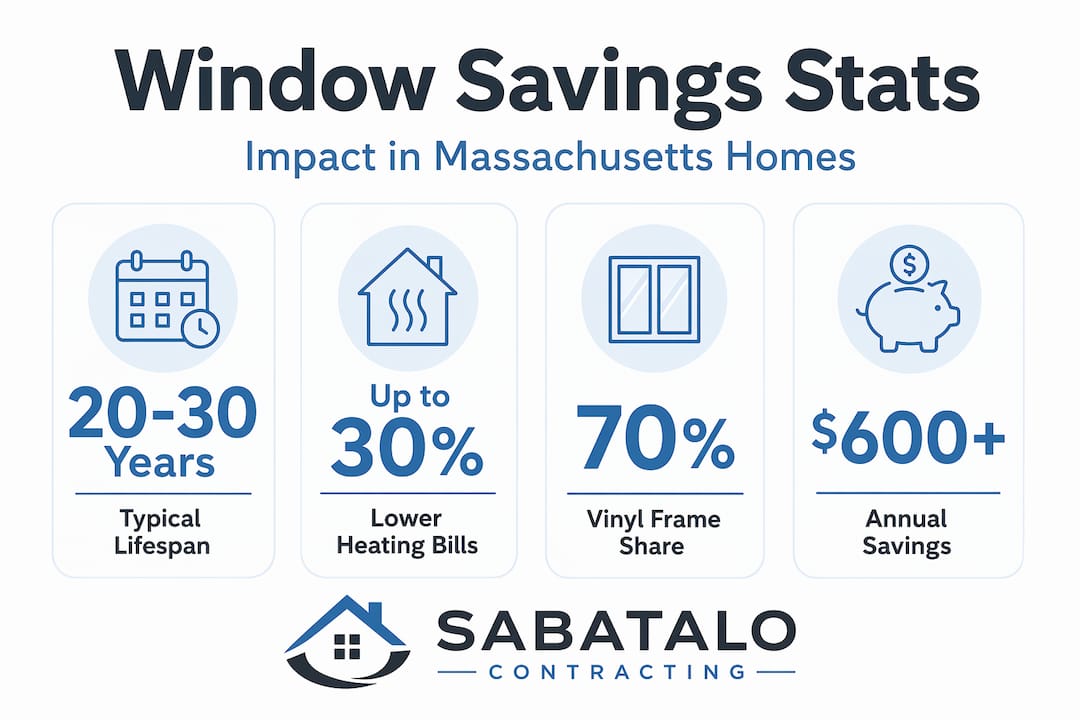
Vinyl frames dominate about 70% of the US market for good reason. They resist moisture, require almost no maintenance, and deliver strong insulation. For most Massachusetts colonials, capes, and ranch-style homes, vinyl A rated windows offer the best return on investment.
Homes with older heating systems, oil heat, or electric baseboard heat see the biggest impact from window upgrades. Those systems work harder to compensate for heat loss, so reducing that loss translates directly into lower runtime and lower bills. If your home still has single-pane windows, you are likely losing 25 to 30 percent of your heating energy through the glass alone.

Pro Tip: Massachusetts homeowners may qualify for federal tax credits on energy-efficient window upgrades. The Energy Efficient Home Improvement Credit allows up to $600 per year for qualifying windows. Check with your tax advisor and confirm the product meets the current ENERGY STAR requirements before purchasing.
Trusted brands for Massachusetts homes
Not all window brands that claim an A rating deliver equally. Consumer trust research from 2026 provides some clear direction. Andersen ranked as the #1 most trusted window brand in America, scoring 113.0 in consumer trust ratings based on 8,508 opinions. Pella followed closely at 112.7, recognized particularly for energy-efficient replacement options.
Here is a quick overview of the top brands worth considering for your Massachusetts project:
- Andersen Windows: Industry leader known for the 100 Series (vinyl-clad) and 400 Series (wood interior). Excellent warranty support and wide dealer network across Massachusetts.
- Pella Windows: Strong reputation for customization options, particularly good for historic or architecturally detailed homes where aesthetics matter as much as performance.
- Marvin Windows: Premium positioning with exceptional build quality. Popular for high-end renovations in eastern Massachusetts. Their Elevate and Infinity lines deliver top-tier insulation.
- Renewal by Andersen: A full-service replacement division with installation included, useful for homeowners who want a single-source solution.
When weighing brand versus material, remember that the frame material itself does most of the performance work. Fiberglass frames offer the best durability for coastal Massachusetts homes, where salt air and humidity put standard vinyl frames under greater stress over time. Wood interiors with fiberglass or aluminum-clad exteriors give you the classic New England look with genuine weather resistance.
Aesthetic and design features worth knowing
Choosing between window styles is not just about appearance. The style you pick affects how well the window seals, how it operates over time, and how well it complements your home’s architecture.
Double-hung windows are the default choice for most Massachusetts homes because they match traditional architecture and allow both top and bottom sashes to open. They are easy to clean and widely available in A rated configurations. Casement windows crank outward and form a tighter seal against drafts, making them a smart choice for bedrooms and living areas facing prevailing winds. Slider windows work well in contemporary-style homes and are easier to operate for spaces above counters or in tight quarters.
Beyond style, these design features significantly affect how a window performs and looks:
- Low-E glass coatings: Low-E coatings and gas fills like argon or krypton between panes improve insulation substantially without blocking natural light. This is non-negotiable for Massachusetts winters.
- Frame color and finish: Darker exterior frames absorb more solar heat, which can be an advantage in winter but a drawback in summer. Lighter frames reflect heat year-round.
- Grille patterns: Colonials grilles, grid patterns, and prairie styles all affect curb appeal. Some manufacturers offer grilles between the glass panes to eliminate cleaning hassles.
- Laminated glass options: For homes near busy roads, laminated glass provides meaningful noise reduction without sacrificing energy performance.
Pro Tip: If your home is in a historic district in Massachusetts, check with your local preservation commission before ordering windows. Some towns require specific colors, grid patterns, or materials that may limit your options before you invest.
Installation and maintenance practices that protect your investment
A rated windows deliver on their promise only when they are installed correctly. This point cannot be overstated. Improper installation can void energy rating benefits entirely and reduce window lifespan by years. The most common installation mistakes are incorrect rough opening measurements, inadequate flashing around the frame, and poor air sealing.
Here is what a quality installation process should include:
- Accurate measurement of rough openings before any window is ordered. Measure twice, order once.
- Removal of old window frames and sills down to the structural framing to check for rot or moisture damage before installation begins.
- Proper flashing installation on all four sides of the opening to redirect any water that gets behind the siding.
- Air sealing with low-expansion foam or fiberglass insulation around the window frame before interior or exterior trim is applied.
- Leveling and shimming so the window operates correctly from day one and the seal stays intact over time.
For ongoing maintenance, vinyl windows need only occasional cleaning with mild soap and water. Wood frames require inspection each spring for paint cracking, soft spots, or signs of moisture intrusion. Fiberglass frames are the most forgiving and need the least attention. Regardless of material, inspect your weatherstripping every two or three years and replace it when it shows compression or cracking. That strip is doing more work than most homeowners realize.
My honest take after years of window projects
I’ve worked with Massachusetts homeowners on window replacements long enough to notice the same pattern over and over. Someone spends considerable time researching the best rated windows, picks a solid A or A+ rated product, and then unknowingly hires the lowest-cost installer on the list. A year later, they notice drafts. The window is fine. The installation failed.
The energy rating on a window is a ceiling, not a guarantee. What you actually get depends on who puts it in and how carefully they do it. In my experience, the homeowners who see the biggest long-term gains are the ones who treat the installation as equal in importance to the product itself.
I also think too many people chase the letter grade without thinking about their specific home. A triple-pane A++ rated window on a south-facing wall in a well-insulated 1990s colonial is probably overkill. A properly installed A rated casement on that same wall, paired with a window replacement that also addresses the air sealing around the rough opening, will likely perform just as well for a meaningfully lower cost. The goal is a comfortable, efficient home. Not the highest grade on paper.
My other piece of advice: think about what the window looks like from the street. You are going to see it every day. The energy-efficient window benefits are real, but so is the curb appeal impact of a window that looks right for your home’s architecture.
— Andrew
How Sabatalocontracting helps you get this right
At Sabatalocontracting, we have spent over 15 years installing replacement windows across Massachusetts, working with homeowners on everything from historic coastal properties to newer suburban builds. We know the local building codes, the climate demands, and which products actually perform here over time.

When you work with Sabatalocontracting, you are not just purchasing a window. You are getting installation done by a crew that understands what Massachusetts winters do to a poorly sealed frame. We carry trusted brands including Andersen and Pella, guide you through ENERGY STAR requirements, and help you understand how your window choices can increase your home’s value alongside their energy performance. If you are ready to get real numbers for your specific home, reach out to Sabatalocontracting for a consultation and quote.
FAQ
What does “A rated” mean on a window?
An A rated window falls near the top of the energy efficiency scale, which runs from G to A++, with A ratings typically corresponding to U-values between 0.8 and 1.1 W/m²K. This means the window loses very little heat and helps reduce heating and cooling costs year-round.
Are A rated windows required in Massachusetts?
Massachusetts follows ENERGY STAR Northern Zone standards, which require a U-factor at or below 0.27 for qualifying windows. While A rated windows often exceed these standards, you should always verify a product meets both the letter grade and the ENERGY STAR Northern Zone criteria before purchasing.
What is the difference between A rated and A+ rated windows?
A+ rated windows have a lower U-value than standard A rated windows, generally below 1.0 W/m²K, offering marginally better insulation. For most Massachusetts homes, A rated windows provide strong performance at a lower price point, while A+ rated options make the most sense in especially cold or drafty homes.
How long do A rated windows last?
Quality A rated windows, when properly installed and maintained, typically last 20 to 30 years. Fiberglass frames tend to have the longest lifespan, while vinyl frames perform reliably with minimal upkeep and wood frames require regular maintenance to reach their full potential.
Will A rated windows reduce my heating bills?
Yes. Upgrading to high performance windows can save Massachusetts homeowners between 7 and 15 percent on annual heating and cooling costs, with the greatest savings in older homes that still have single-pane or low-quality double-pane windows.
