TL;DR:
- Most Massachusetts decks require a permit if attached, over 30 inches high, or over 200 sq ft.
- Local town rules can add stricter requirements beyond state code, impacting permitting.
- Working with experienced contractors simplifies the permit process and ensures code compliance.
Many Massachusetts homeowners assume a small backyard deck falls under the radar, no permit needed, no inspection, no fuss. That assumption can be expensive. Local building departments across the state enforce rules that go beyond what the state code technically requires, and getting caught without a permit can mean fines, forced removal, or insurance headaches you never saw coming. This guide walks you through exactly when a permit is required, what the building code demands, how local rules add extra layers, and the practical steps to get your permit approved without unnecessary delays.
Table of Contents
- When do you need a deck permit in Massachusetts?
- What the building code requires: Key specs for decks
- Local rules and special cases: Town, historic, and site specifics
- How to apply for your Massachusetts deck permit
- Our perspective: What most homeowners get wrong about deck permits
- Get expert help for a smooth deck project
- Frequently asked questions
Key Takeaways
| Point | Details |
|---|---|
| Most decks need permits | Massachusetts law requires building permits for nearly all new decks, especially those over 30 inches high or attached to the home. |
| Local rules can override state exemptions | Town regulations may be stricter than state code, so always check with your city’s building department—even small decks can require a permit. |
| Follow code for safe construction | Decks must meet requirements for lumber, footings, guards, and frost protection to pass inspection and ensure safety. |
| Prepare the right documents | Successful permit applications need accurate plans, material specs, and might require an engineer’s stamp for complex designs. |
| Professional help simplifies the process | Hiring an experienced contractor can help you navigate permits, avoid mistakes, and speed up your deck project. |
When do you need a deck permit in Massachusetts?
The short answer: more often than you think. Most residential decks in Massachusetts require a building permit from the local building department, governed by the 10th Edition Massachusetts State Building Code (780 CMR), which is based on the International Residential Code with state-specific amendments. That code sets the baseline, but your local town can add stricter requirements on top of it.
So what actually triggers a permit requirement? Permits are typically required when your deck is attached to the house, stands more than 30 inches above grade (ground level), covers more than 200 square feet, or uses structural footings. If your project hits even one of those conditions, you need a permit.
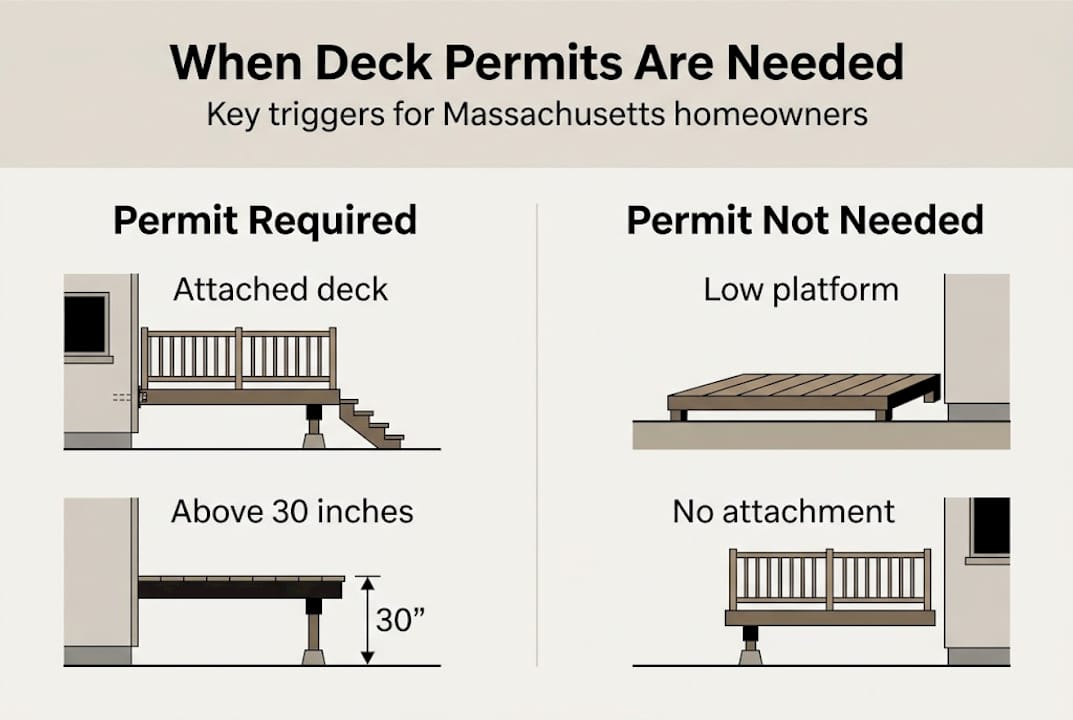
Here is a quick comparison to help you gauge where your project falls:
| Deck type | Permit typically required? |
|---|---|
| Attached to house | Yes |
| Over 30 inches above grade | Yes |
| Over 200 sq ft | Yes |
| Has structural footings | Yes |
| Small freestanding, under 200 sq ft, under 30" | Check locally |
There are limited exemptions for small, low freestanding decks, but this is where homeowners get into trouble. The state code may technically allow an exemption, but many towns do not honor it. Some require permits for any deck, regardless of size. Understanding Massachusetts permit requirements for exterior projects is always worth the extra step.
What happens if you skip the permit? The consequences are real:
- Fines from your local building department
- Stop-work orders that halt construction mid-project
- Forced removal of the unpermitted structure
- Insurance claim denials if the deck is involved in an accident
- Problems selling your home when the unpermitted work surfaces during inspection
Pro Tip: Before you draw up a single plan, call your city or town building department and ask directly whether your specific project needs a permit. A five-minute phone call can save you thousands of dollars and months of headaches.
Scheduling deck safety inspections as part of your process also protects you long-term. And for a broader look at how MA home improvement law applies to your project, the state provides clear guidance.
What the building code requires: Key specs for decks
Once you know you need a permit, you need to understand what your deck must actually look like on paper and in the field. The MA deck code details cover everything from lumber grade to how deep your footings must go.
Here are the core technical requirements you will encounter:
| Requirement | Specification |
|---|---|
| Lumber grade | Treated No. 2 or better |
| Footing depth | Minimum 12 inches below grade; frost depth 42 to 48 inches in most of MA |
| Guardrails required | When deck surface is more than 30 inches above grade |
| Guardrail height | Minimum 36 inches; 42 inches for commercial |
| Ledger attachment | Must use approved fasteners and flashing |
| Fasteners and hardware | Must be corrosion-resistant (hot-dipped galvanized or stainless steel) |
Footings deserve special attention. Massachusetts has a frost depth of roughly 42 to 48 inches in most regions. That means your footings must extend below that depth to prevent heaving during freeze-thaw cycles. A deck that shifts or tilts because of shallow footings is not just an aesthetic problem. It is a safety hazard.
“The ledger board connection is the single most critical structural element on an attached deck. Improper ledger attachments are a leading cause of deck collapses.”
Here is a numbered checklist to work through when preparing your plans:
- Confirm lumber species and grade meet Treated No. 2 minimum
- Calculate footing size and depth based on load and frost depth
- Specify guardrail height and baluster spacing (maximum 4-inch gap)
- Detail ledger attachment method with approved hardware
- Include joist sizing, span tables, and beam calculations
- List all fastener types and confirm corrosion resistance
- Note snow load design values for your region of Massachusetts
Pro Tip: Using pressure-treated lumber rated for ground contact and pairing it with stainless steel or hot-dipped galvanized fasteners will not only help you pass inspection but will also extend the life of your deck by years. Mixing incompatible metals causes accelerated corrosion.
For more detail on deck inspection safety rules and what inspectors look for, reviewing those standards before you submit your plans can save a round of revisions. If you are also considering repairing deck boards as part of a renovation, the same code specs apply.
Local rules and special cases: Town, historic, and site specifics
State code is the floor, not the ceiling. Individual towns in Massachusetts can and do add requirements that go beyond what 780 CMR mandates. This is where many homeowners get surprised.

Boston is a clear example. Roof decks require special permits in Boston, with additional structural review and fire safety considerations that do not apply to a standard backyard deck in a suburban town. The city has its own permitting portal and requirements that go well beyond the state baseline.
Here are the additional layers you may encounter depending on your location or property type:
- Historic district approval: Many towns require a Certificate of Appropriateness from a local historic commission before you can even apply for a building permit. Materials, colors, and design details may be restricted.
- HOA restrictions: Homeowners associations often have their own design guidelines. Their approval does not replace a building permit, but you may need both.
- Flood zone requirements: If your property is in a FEMA-designated flood zone, your deck may need to meet elevation requirements and use flood-resistant materials.
- Engineering stamps: Towns with stricter enforcement or complex site conditions may require a licensed structural engineer to stamp your plans before the building department will accept them.
- Zoning setbacks: Your deck must comply with local zoning rules about how close structures can be to property lines, wetlands, and other boundaries.
Towns like Wrentham, Groton, and others have adopted local amendments to the state deck code that reflect their specific community needs. What is acceptable in one town may require additional review in the next.
Pro Tip: Bring a rough sketch of your deck to your local building official before finalizing your plans. Most officials are happy to give informal feedback, and a 20-minute conversation can prevent weeks of back-and-forth after submission.
Working with experienced deck contractors for permit help is especially valuable in towns with complex local rules. If you are not sure which towns we cover, our local service areas page has the full list.
How to apply for your Massachusetts deck permit
Knowing the rules is one thing. Getting the permit in hand is another. Here is how the process works in practice.
Step-by-step permit application process:
- Prepare your documents. You will need a site plan showing your property lines and deck location, construction drawings with dimensions and structural details, a materials list with lumber grades and fastener specs, and an engineer-stamped plan if your town or project complexity requires it.
- Visit your local building department. Most towns in Massachusetts require in-person submission or have an online portal. Confirm which method your town uses before preparing your package.
- Submit your application and pay the fee. Permit fees vary by town and project size. Budget anywhere from $50 to several hundred dollars depending on your municipality.
- Wait for plan review. Review timelines range from a few days to several weeks. Larger towns with busier departments take longer. Incomplete applications are the most common cause of delays.
- Respond to any comments. If the reviewer requests changes or additional information, address them promptly to avoid losing your place in the queue.
- Receive your permit and post it on-site. The permit must be visibly posted during construction.
- Schedule required inspections. Most towns require a footing inspection before pouring concrete and a final inspection when the deck is complete.
The question of DIY versus hiring a contractor matters here. Homeowners can apply themselves if they are doing the work personally, but local departments can be stricter than state minimums, and an incomplete application wastes everyone’s time. Many homeowners find it easier to let a registered contractor handle the permit process entirely.
Common mistakes that delay permit approval:
- Missing or unclear construction drawings
- Incorrect footing depth specified for local frost conditions
- No ledger attachment detail shown
- Failing to include a site plan with setback dimensions
- Using non-approved materials or hardware specifications
For guidance on working with a deck contractor who manages the permit process for you, that option removes most of these friction points entirely.
Our perspective: What most homeowners get wrong about deck permits
After years of helping Massachusetts homeowners build and upgrade their decks, we have seen the same mistake repeat itself. A homeowner reads about a state exemption for small freestanding decks, assumes it applies to their town, and starts building. Then the building inspector shows up.
Here is the uncomfortable truth: state-level exemptions are almost always overridden by local enforcement. The towns we work in regularly require permits for decks that technically fall under the state exemption threshold. Local officials have the authority to be stricter, and most of them use it.
The other thing we see is outdated information. Someone finds a forum post from 2015 that says their town does not require permits for decks under a certain size. That information may no longer be accurate. Codes get updated, local ordinances change, and what was true five years ago may not be true today.
Our advice is simple: always verify directly with your local building department, keep copies of everything you submit, and never rely on secondhand information for a decision that affects your home’s safety and value. A quick call is always worth it. For a closer look at what deck inspection perspective means for long-term safety, that resource is a good starting point.
Get expert help for a smooth deck project
Navigating Massachusetts deck permits does not have to be stressful. With the right contractor by your side, the paperwork, code compliance, and inspection scheduling are handled for you from start to finish.

At Sabatalo Contracting, our local deck experts bring over 15 years of experience working with Massachusetts building departments across dozens of towns. We know the local rules, we prepare complete permit packages, and we build decks that pass inspection the first time. Whether you are planning a new deck, upgrading your siding, or exploring a full exterior renovation, our trusted roofing contractors and home improvement team are ready to help. Contact Sabatalo Contracting today to request a free consultation and get your project moving in the right direction.
Frequently asked questions
Do I need a permit for a small freestanding deck in Massachusetts?
Many towns still require a permit for freestanding decks even when they fall under the state exemption threshold, so always confirm with your local building department before you start.
How long does it take to get a deck permit in Massachusetts?
A deck permit review can take anywhere from several days to a few weeks, depending on your town’s workload and whether your application is complete and accurate when submitted.
What happens if I build a deck without a permit in MA?
You risk fines, a stop-work order, and forced removal of the structure, and skipping permitting can also create serious insurance problems and complicate a future home sale.
Do I need an engineer or contractor to apply for a deck permit?
Homeowners can apply for their own permit when doing DIY work, but large or structurally complex decks often require engineered plans, and many homeowners hire a contractor to manage the process.
Do building codes for decks change often in Massachusetts?
Massachusetts follows the State Building Code, which is updated periodically, so always confirm you are referencing the current edition before finalizing your construction plans.
