TL;DR:
- Insulated siding enhances energy efficiency, comfort, and durability beyond cosmetic improvements.
- It adds R-2 to R-5 insulation, reducing heat loss and potential energy savings of 10 to 15%.
- Suitable for older homes with poor insulation, especially when combined with air sealing and other upgrades.
Most Massachusetts homeowners think of siding as a purely cosmetic upgrade. Pick a color, maybe freshen up the curb appeal, and move on. But that thinking leaves real money on the table. Insulated siding does far more than improve appearances. It directly affects your monthly energy bills, the comfort of your living spaces during brutal New England winters, and the long-term durability of your home’s exterior. This guide breaks down exactly what insulated siding delivers, what it costs, and how to decide whether it’s the right investment for your specific property.
Table of Contents
- What is insulated siding and why consider it?
- Energy efficiency and comfort: Numbers you can expect
- Comparing costs: Upfront investment vs. long-term value
- Is insulated siding right for your Massachusetts home?
- Our take: What most homeowners miss about insulated siding value
- Explore your options with local experts
- Frequently asked questions
Key Takeaways
| Point | Details |
|---|---|
| Energy and comfort boost | Insulated siding delivers noticeably cozier rooms and can lower heating and cooling bills by 10–15% for many Massachusetts homes. |
| More than just looks | Beyond curb appeal, insulated siding reduces maintenance, adds durability, and enhances your property’s value. |
| Best value for older homes | Massachusetts homes with poor wall insulation gain the most from this upgrade—especially when combined with air sealing. |
| Financial help available | Mass Save offers rebates and loans to help Massachusetts homeowners offset insulated siding and insulation costs. |
What is insulated siding and why consider it?
Insulated siding is not just standard vinyl siding with a marketing spin. It’s a product that bonds a layer of rigid foam insulation, typically expanded polystyrene (EPS), directly to the back of the siding panel. That foam layer fills the gap between the siding and your exterior wall, reducing thermal bridging (the process where heat escapes through the wall studs instead of staying inside your home).
Standard vinyl siding sits against your wall with an air gap. That gap does very little to slow heat loss. Insulated siding eliminates that gap and adds measurable R-value (resistance to heat flow) to your wall assembly. Typical insulated siding panels add between R-2 and R-5, depending on the foam thickness. That’s not a dramatic number on its own, but it works on top of whatever insulation already exists in your wall cavities.
Here’s what insulated siding actually adds to your home:
- Thermal performance: The foam backing reduces heat loss through exterior walls, especially at wall studs where standard insulation performs poorly.
- Noise reduction: The dense foam layer dampens outdoor noise, which is noticeable in neighborhoods near busy roads or highways.
- Aesthetic depth: Insulated siding panels sit flatter against the wall and look more like real wood because the foam prevents the wavy, hollow look common with thin standard panels.
- Impact resistance: The solid foam backing absorbs impact better than hollow-back panels, reducing dents from hail, debris, or yard tools.
- Structural support: The foam gives the panel more rigidity, which helps it hold up against wind-driven rain and Massachusetts storms.
Massachusetts homes face real challenges that make insulated siding especially relevant. Winters regularly push temperatures into the single digits, and the freeze-thaw cycles stress every part of your exterior. Older homes, many of which were built before modern insulation standards became common, often have wall cavities with little to no insulation. For those properties, every layer of thermal protection matters.
“Insulated siding is most beneficial for older homes with poor cavity insulation.”
If you already suspect your siding is showing its age, learning the signs you need new siding can help you confirm whether a replacement is overdue and whether upgrading to an insulated product makes sense at that point.
Energy efficiency and comfort: Numbers you can expect
The foam backing in insulated siding improves your wall’s ability to resist heat loss. But how much does that actually show up in your energy bills? Let’s look at the real numbers.
R-value is the standard measurement of insulation performance. A typical Massachusetts home with 2×4 wall framing and fiberglass batt insulation has a wall R-value around R-13 to R-15 in the cavity, but the overall effective R-value drops because of thermal bridging through the studs. Adding insulated siding with R-3 to R-5 can increase your effective wall R-value meaningfully, because it wraps the entire wall surface, not just the spaces between studs.
| Feature | Standard siding | Insulated siding |
|---|---|---|
| Added R-value | R-0 to R-0.5 | R-2 to R-5 |
| Thermal bridging reduction | None | Significant |
| Wall surface temperature | Cold in winter | Noticeably warmer |
| Draft reduction near walls | Minimal | Noticeable improvement |
In real terms, energy savings of 10 to 15% on heating and cooling costs is a realistic target for Massachusetts homes, even though some marketing materials push claims of 20% or more. For a typical Massachusetts household spending $2,400 per year on energy, that range translates to $240 to $360 saved annually. Over 20 years, that’s a meaningful number, especially when combined with reduced maintenance costs.
Comfort improvements often matter just as much as the dollar savings. Homes with poor exterior insulation have cold interior walls during winter. That cold surface lowers the perceived comfort of the room, even when the air temperature is set at 70°F. After insulated siding installation, homeowners frequently report that rooms along exterior walls feel noticeably warmer and more comfortable, with fewer drafts near windows and baseboards.
Pro Tip: If your home has drafty rooms along north-facing or west-facing exterior walls, insulated siding can make a bigger difference there than almost any other single upgrade. Pair it with energy efficient windows and you’ll feel a dramatic change in those rooms during the coldest months.
Massachusetts homeowners also have access to financial support through Mass Save, the state’s energy efficiency program. The Mass Save insulation rebates program can cover 75% to 100% of insulation costs up to $2,000 for eligible projects, with no-cost options for income-eligible households. The program also offers 0% HEAT Loans up to $25,000. If your insulated siding installation includes wall insulation work, it may qualify under these programs, but you’ll need to start with a no-cost home energy assessment to determine eligibility.
Combining insulated siding with other envelope improvements amplifies the results. For example, pairing a siding upgrade with energy savings from new doors creates a more airtight exterior shell. Think of your home’s thermal envelope like a winter jacket. Fix one gap and you still feel cold. Fix all of them together and the difference is striking.
Comparing costs: Upfront investment vs. long-term value
Let’s address the most direct question: what does insulated siding actually cost, and does the investment make financial sense?
Insulated vinyl siding typically costs between $7 and $12 per square foot installed, depending on the product grade, foam thickness, and labor in your area. Standard vinyl siding runs closer to $4 to $7 per square foot installed. For a 2,000 square foot home with 1,500 square feet of exterior wall surface, that gap in cost could be $4,500 to $7,500 more for the insulated option.
| Cost factor | Standard siding | Insulated siding |
|---|---|---|
| Installed cost per sq ft | $4 to $7 | $7 to $12 |
| Repainting needed | Every 5 to 10 years | Never |
| Expected lifespan | 20 to 25 years | 25 to 40 years |
| Impact resistance | Low to moderate | High |
| Estimated annual energy savings | Minimal | $240 to $360 |
That upfront gap narrows considerably when you factor in the long-term differences. Standard wood or fiber cement siding requires repainting every five to ten years. In Massachusetts, exterior painting typically costs $3,000 to $8,000 per job. Over 20 years, that’s potentially $6,000 to $16,000 in painting costs alone, which insulated vinyl siding completely eliminates.
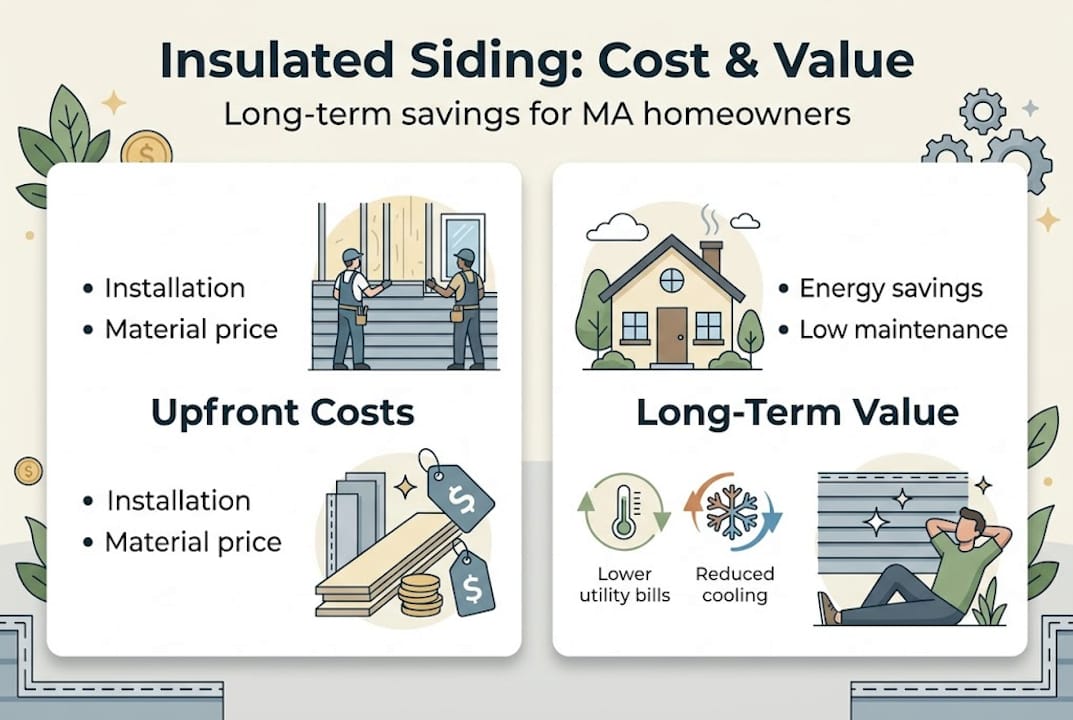
Insulated siding carries a higher upfront price but makes up for it through no-paint maintenance, strong impact resistance, and a lifespan that often outlasts standard options by 10 to 15 years. When hail or debris dents a standard hollow-back panel, it tends to crack or deform permanently. Insulated panels absorb that same impact far better and show less visible damage.
There are cases where the extra investment may not pay off as strongly. If your home already has thick wall insulation and a newer exterior, the comfort and energy gains from insulated siding will be smaller. In that scenario, the additional cost over standard siding becomes harder to justify on energy savings alone. However, the durability and low-maintenance benefits still apply.
Understanding the full picture of siding replacement costs is an important step before committing to any project. The right contractor can help you evaluate which product tier delivers the best return for your specific property.
“The real financial case for insulated siding isn’t just the energy savings line. It’s the combination of reduced maintenance, extended lifespan, and comfort improvements that add up over time.”
Is insulated siding right for your Massachusetts home?
Not every home benefits equally from insulated siding. Before committing to the upgrade, it helps to honestly assess your property’s current condition and what you’re trying to achieve.
Here are the attributes that make a home an ideal candidate for insulated siding:
- Age of 30 years or older. Older homes were often built with minimal or no wall cavity insulation, making the foam backing in insulated siding significantly more impactful.
- Visible or suspected comfort issues. If you have cold rooms along exterior walls, visible drafts in winter, or unusually high heating bills, your walls are likely underperforming thermally.
- Existing siding showing wear. If your siding is due for replacement anyway, upgrading to an insulated product adds real value without a full tear-down project.
- Planning to stay long-term. The payback period for the extra cost of insulated siding is typically 8 to 15 years. If you plan to stay in your home for at least a decade, the math works.
- No recent exterior wall upgrades. Homes that haven’t had exterior insulation added in the past 20 years are the strongest candidates.
On the other hand, there are cases where insulated siding adds less incremental value. Well-insulated newer homes may not see significant energy performance gains from the foam backing, since their wall assemblies already perform at a high level. In those cases, standard siding with a quality paint system might be the more cost-effective choice.
One critical factor that many homeowners overlook is air sealing. Insulated siding improves your wall’s thermal resistance, but it doesn’t stop air from leaking in through gaps around windows, doors, electrical outlets, and other penetrations. If your home has significant air leakage, some of the expected energy gains from insulated siding simply won’t materialize. Before investing in new siding, make sure your contractor addresses air sealing as part of the project scope.
Pro Tip: Ask your contractor to perform or arrange a blower door test before siding installation. This simple diagnostic pressurizes the house and reveals exactly where air is escaping. Sealing those gaps before new siding goes on will substantially increase your energy savings and make the insulated siding work harder for you.
Evaluating your home honestly is a lot easier with professional input. Working with trusted Massachusetts siding contractors who understand local climate demands, housing stock, and building codes means you get a clear picture of what your specific home needs, not just a generic sales pitch.
Our take: What most homeowners miss about insulated siding value
Here’s what we’ve learned after working on homes across Massachusetts for over 15 years. The payback calculations you see in most guides are incomplete. They measure energy savings and compare them to upfront costs. But they rarely put a dollar figure on comfort, and comfort is often what drives homeowners to act in the first place.
A room that used to be unusable in January because the exterior wall felt like a refrigerator is now a comfortable office or living space. That quality-of-life shift has real value that doesn’t show up in an energy bill comparison.
Massachusetts is also a unique market because of its climate swings and its aging housing stock. A huge percentage of homes in this state were built before 1980, before energy codes became meaningful. Those homes are where insulated siding delivers its strongest performance gains, by a wide margin.
We also see consistently better outcomes when homeowners treat the siding upgrade as part of a broader exterior improvement plan. Pairing new insulated siding with upgrading windows and proper air sealing creates a compounding effect. Each individual upgrade improves the envelope, but together they transform how a home performs. The return on that combination is significantly higher than any single upgrade in isolation.
Don’t just calculate payback in years. Calculate what it’s worth to be comfortable in every room of your house, every month of the year.
Explore your options with local experts
If insulated siding sounds like a strong fit for your Massachusetts home, the next step is a conversation with someone who knows local housing conditions, not a national call center.

At Sabatalo Contracting, we’ve been upgrading Massachusetts homes for over 15 years. We understand what your home is up against every winter and can walk you through the right siding products, thickness options, and installation methods to maximize your results. We also help homeowners understand how to increase home value with exterior upgrades beyond siding alone. Ready to explore what’s possible? Connect with our qualified siding contractors for a consultation and start building a plan that works for your home and your budget.
Frequently asked questions
How much energy can I really save with insulated siding in Massachusetts?
Most Massachusetts homeowners see savings of 10 to 15% on heating and cooling costs when upgrading to insulated siding, depending on their home’s age and existing insulation.
Are there rebates available for insulated siding installation in Massachusetts?
Yes, through Mass Save rebates, coverage of 75% to 100% of insulation costs up to $2,000 may apply, especially if siding installation is part of a broader wall insulation upgrade.
Does insulated siding pay off if my house is already well-insulated?
The extra value is less significant for newer, well-insulated homes. It is most worthwhile for older homes with poor cavity insulation where the foam backing delivers meaningful thermal gains.
Is insulated siding difficult to maintain?
No painting is needed with insulated vinyl siding, and maintenance is minimal. You get strong impact resistance and a longer lifespan compared to painted wood or fiber cement alternatives.
What’s the most important step before installing insulated siding?
Proper air sealing is critical before installation. Without it, air leaks around windows, doors, and penetrations can undermine much of the energy efficiency benefit the siding would otherwise provide.
