
TL;DR:
- Storm windows offer cost-effective energy savings of 10% to 30% without full window replacement.
- Proper installation ensures storm windows reduce drafts, improve comfort, and prevent moisture issues.
- They are ideal for historic homes and budgets, complementing broader weatherization efforts.
When Massachusetts homeowners think about cutting heating bills or stopping drafts, replacing every window in the house feels like the obvious answer. But that assumption costs a lot of money that you may not need to spend. Low-e storm windows can deliver energy savings comparable to full replacement at roughly one-third the cost, with modeled heating and cooling savings between 10% and 30%. This article walks you through what storm windows are, why they work so well in Massachusetts winters, how installation affects performance, and how they fit into a smarter, more affordable weatherization plan.
Table of Contents
- What are storm windows and how do they work?
- Top storm window benefits for Massachusetts homes
- Installation, weatherization, and moisture considerations
- Storm windows, incentives, and your Massachusetts weatherization plan
- What most people miss about storm window upgrades
- Take the next step for a more comfortable, energy-smart home
- Frequently asked questions
Key Takeaways
| Point | Details |
|---|---|
| Significant energy savings | Storm windows can cut heating and cooling costs by up to 30 percent, rivaling full replacements but at a lower price. |
| Enhanced home comfort | Expect fewer drafts and more consistent temperatures after adding storm windows to older homes. |
| Smart for Massachusetts | Storm windows are a practical, cost-effective way to boost efficiency and protect your home against harsh local weather. |
| Installation quality matters | Proper drainage, fit, and sealing are key to long-term performance and avoiding moisture issues. |
What are storm windows and how do they work?
Storm windows are secondary panels installed directly over your existing windows, either on the interior or exterior side of the frame. They create a buffer zone, essentially a pocket of still air between the storm panel and the original window. That buffer acts like extra insulation, slowing heat transfer in both directions. In winter, your heated air stays inside longer. In summer, the outdoor heat takes more time to penetrate your living spaces.
Understanding the different types makes it easier to choose the right fit:
- Exterior storm windows mount on the outside of your window frame. They are the most common type and offer strong protection against wind, rain, and debris. Many come in aluminum or vinyl frames with interchangeable glass and screen panels.
- Interior storm windows are installed on the inside of the frame. They are often removable and are especially popular in historic homes where exterior appearance matters.
- Clear glass storm windows improve performance simply by adding that insulating air gap, blocking drafts, and reducing noise from the street.
- Low-e storm windows take things further. Low-e stands for low emissivity, which means the glass has a thin metallic coating that reflects heat back toward its source. In winter, that means radiant heat from your furnace stays inside. In summer, solar heat reflects back outside before it enters your home.
Compared to full window upgrades in Massachusetts, storm windows work on top of what you already have rather than removing and replacing the entire window unit. This is important because many older homes in Massachusetts, particularly those built before 1960, have solid wood frames that actually perform well structurally. Replacing them entirely removes materials that are still functional and raises installation costs sharply.
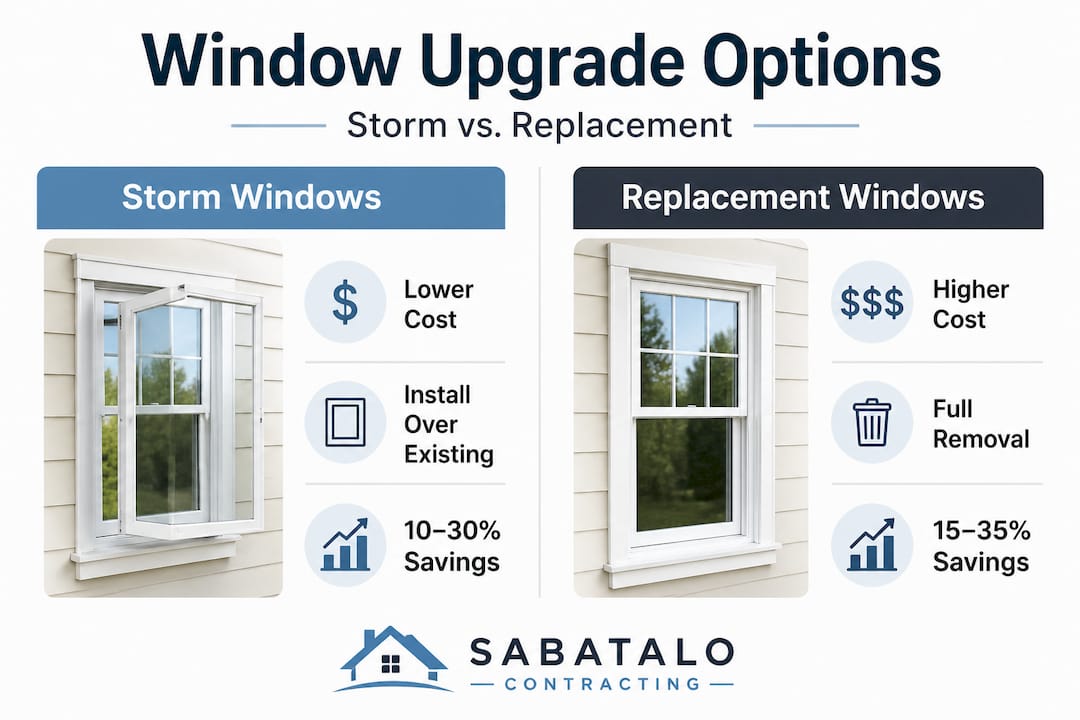
| Feature | Storm windows | Replacement windows |
|---|---|---|
| Average installed cost | $150 to $400 per window | $400 to $1,200+ per window |
| Preserves original window | Yes | No |
| DIY friendly | Somewhat | Rarely |
| Energy savings potential | 10% to 30% | 10% to 35% |
| Best for historic homes | Yes | Sometimes restricted |
The key takeaway here is that storm windows reduce drafts and air movement while lowering heating and cooling loads for existing windows, making them one of the most practical upgrades available for older Massachusetts homes.
Top storm window benefits for Massachusetts homes
Massachusetts winters are no joke. Cold air pours in through gaps around window frames, condensation forms on single-pane glass, and energy bills climb from November through March. Storm windows directly address all of these problems without a full replacement price tag.
Here is what you actually gain by adding storm windows:
- Fewer drafts: The air gap between the storm panel and your existing window breaks the path of infiltration, meaning cold air from outside has a harder time reaching your interior space.
- More even temperatures: Rooms near exterior walls stay warmer in winter and cooler in summer, which makes a noticeable difference in comfort even before your energy bill reflects the savings.
- Noise reduction: The added glass layer absorbs and reflects sound, particularly useful if you live near a busy road or a school.
- Protection for original windows: The storm window takes the direct impact of weather, reducing wear on the underlying window and extending its useful life.
- Preservation of historical character: Massachusetts has a large stock of older homes, and many towns restrict exterior changes. Interior storm windows let you improve performance without altering the look of original wood windows.
The financial case is strong. Low-e storm windows cut heating and cooling costs by 10% to 30% depending on your existing window type, with performance that approaches what you get from a full replacement unit. For a home spending $2,400 per year on heating alone, a 20% reduction means $480 back in your pocket annually. That math adds up quickly when storm windows cost a fraction of replacement.

Pro Tip: If you are choosing between clear glass and low-e storm windows, always prioritize low-e for south-facing and west-facing windows. Those are the sides of your home that absorb the most solar heat in summer and lose the most heat through radiation in winter. You will see the biggest return there.
| Window type | Typical U-value | Storm window added U-value | Estimated savings range |
|---|---|---|---|
| Single pane, clear | 1.0 | 0.50 to 0.55 | Up to 30% |
| Single pane with film | 0.80 | 0.45 to 0.52 | 20% to 28% |
| Double pane, older | 0.50 | 0.38 to 0.44 | 10% to 18% |
The U-value measures heat transfer through a window, so a lower number means better insulation. As the table shows, the older and less efficient your existing windows are, the more storm windows help.
For homeowners who want to compare storm windows against other glass options, looking at ENERGY STAR windows in Massachusetts and the full range of energy efficient window options gives you the complete picture. That context matters when you are building a long-term plan for your home.
It is also worth noting that storm windows help reduce air movement into and out of existing windows, which directly improves comfort in rooms that previously felt impossible to heat evenly. This effect is often what homeowners notice first, even before they see their energy bills change.
Installation, weatherization, and moisture considerations
Getting the benefits on paper is one thing. Getting them in real life requires correct installation. This is where many homeowners and even some contractors fall short, and it is worth spending time here because mistakes are common and costly.
Good storm window installation involves more steps than simply screwing a panel into a frame. Here is what a proper installation process covers:
- Measure the existing window frame carefully, accounting for any irregularities in older frames. A storm window that does not fit flush creates gaps that defeat its entire purpose.
- Clean and prepare the frame surface so that weatherstripping and caulk can bond properly. Paint peeling or dirt on the frame breaks the seal.
- Apply weatherstripping around the perimeter of the storm window frame to eliminate air infiltration at the edges.
- Caulk exterior joints where the storm window meets the existing frame, but leave the bottom weep holes or drainage paths open. This is a step many people skip, and it matters.
- Check for proper drainage by inspecting the bottom of the storm window after a rain event. Water that cannot escape becomes a moisture problem that can rot your original wood window from the outside in.
- Test the window seal by running your hand around the perimeter on a cold day. Any movement of air means the seal needs adjustment.
“Air sealing at frame interfaces and maintaining drainage pathways are essential to realizing energy and comfort gains and avoiding moisture problems.” Weatherizing and air sealing is the foundation of any successful storm window installation.
Condensation is a specific concern that worries many homeowners before they install storm windows. It can and does happen, but it is manageable. When moist indoor air reaches a cold surface, it forms droplets. With storm windows installed, the original window glass stays warmer because the storm window is now the cold surface. This typically reduces condensation on the original window. However, if moisture gets trapped between the storm panel and the original window without a drainage path, it can cause problems.
Moisture and condensation performance depends directly on installation quality and airflow. Properly installed storm windows with appropriate drainage and ventilation prevent the most common moisture problems.
Pro Tip: Before adding storm windows, check the condition of your existing windows. If the glazing compound (the putty that holds the glass in the frame) is cracked or missing, repair it first. A storm window over a deteriorated window seal will trap moisture and accelerate decay rather than protect against it. Consider reviewing affordable window replacement options if the original window is already too far gone to salvage. For homes with older below-grade windows, the energy efficient basement window options offer additional options worth exploring.
Storm windows, incentives, and your Massachusetts weatherization plan
Storm windows do not exist in isolation. They work best as part of a broader plan that includes air sealing, insulation, and other weatherization steps. Massachusetts homeowners have access to several programs that support this kind of whole-home approach.
MassCEC recognizes storm windows as a recommended weatherization step alongside weatherstripping, caulking, and other air-sealing measures. That recognition matters because it means storm windows fit neatly into the same plan as attic insulation, basement rim joist sealing, and door upgrades. Doing these together compounds the savings rather than stacking them.
Here is when storm windows make more sense than full replacement:
- Your existing windows are structurally sound but single-pane or drafty
- Your home is in a historic district with restrictions on exterior changes
- Your budget is limited and you need to prioritize spending across multiple upgrades
- You plan to sell in the near term and want visible, practical improvements without major capital outlay
- Your main window frames are solid wood and still performing structurally
Here is when full replacement may be the better call:
- Your window frames are rotted, warped, or structurally compromised
- You have failed double-pane seals showing foggy glass between panes
- Your windows are so out of square that a storm window cannot seal properly against them
- You want to maximize long-term resale value with a fully modern window system
Regarding incentives, it is important to set realistic expectations. Massachusetts energy program incentives typically focus on replacing qualifying single-pane windows with top-tier ENERGY STAR certified models. Storm window additions are generally evaluated separately from replacement-focused rebate programs. That does not make them a bad investment. It simply means the financial calculation sits in operating savings rather than upfront rebates.
Pairing storm windows with other weatherization steps gives you the best total return. The energy savings with new windows page outlines how different window improvements interact with overall home energy use, which can help you build a realistic plan.
What most people miss about storm window upgrades
Here is something we have seen repeatedly after years of working on Massachusetts homes: homeowners overthink the window replacement decision and underthink the installation quality decision.
The industry has done a good job marketing full replacement as the only serious path to better efficiency. But the data does not fully support that story when you look at the cost-per-unit-of-savings comparison. Storm windows, particularly low-e versions, routinely deliver 80% to 90% of the efficiency gains of a full replacement at roughly 30% of the cost. That is not a small difference. It means you could upgrade every window in a 20-window home with storm panels for less than the cost of replacing six or eight windows outright.
The problem we see most often is not the product choice. It is skipped steps during installation. A storm window with no weatherstripping, blocked drainage holes, or gaps at the corners performs almost as poorly as no storm window at all. The product is fine. The installation made it fail.
The other thing most homeowners miss is how storm windows interact with the rest of the building envelope. A house with well-sealed storm windows but no attic insulation is still a house with a significant heat loss problem. Conversely, a well-insulated house with leaky old windows is losing meaningful energy through the glass and the frame gap. Storm windows, when combined with basic air sealing around the frame, solve both problems at once.
Before you call for a full window replacement quote, take an honest look at your windows using the window replacement timing guide. You may find that storm windows buy you five to ten additional years of comfortable, efficient performance while you save toward a more complete upgrade. That is not settling. That is smart home management.
Take the next step for a more comfortable, energy-smart home
Making the right call for your windows takes more than reading an article. It takes eyes on the actual frames, an honest assessment of your current window condition, and a plan that fits your budget and your long-term goals for your home.

At Sabatalo Contracting & Home Improvement, we have spent more than 15 years helping Massachusetts homeowners figure out exactly this kind of question. We look at what you actually have before we recommend what you should do next. If storm windows are the right fit, we will install them correctly, with proper sealing, drainage, and integration into your broader exterior plan. If your windows have crossed the line into replacement territory, we can walk you through the full range of options, including how siding and window replacement costs work together when you are planning multiple upgrades. Every improvement we make is designed to increase your home’s value and protection for the long term. Reach out for a consultation and let’s build a plan that actually makes sense for your home.
Frequently asked questions
What’s the difference between storm windows and replacement windows?
Storm windows install over your existing windows to improve efficiency and comfort, while replacement windows fully remove the old unit and install a new one in its place. Low-e storm windows provide savings comparable to full replacement in many cases at about one-third of the cost.
How much can I save by installing storm windows?
With well-installed low-e storm windows, you can expect heating and cooling savings of 10% to 30% depending on how efficient your existing windows already are. Older single-pane windows show the biggest improvements.
Will storm windows cause moisture or condensation problems?
Properly installed storm windows actually reduce condensation on your original window by keeping it warmer. Condensation and moisture performance depends on correct installation with functioning drainage and ventilation at the base of the frame.
Are there rebates for installing storm windows in Massachusetts?
Most Massachusetts energy program rebates focus on replacing single-pane windows with ENERGY STAR certified models rather than adding storm windows, but storm windows are still recognized as a recommended weatherization upgrade with strong operating savings.
Recommended
- Energy efficient windows in Massachusetts: save money | Sabatalo Contracting
- Energy Star Windows: Boosting Comfort and Savings in MA | Sabatalo Contracting
- Energy Efficient Impact Windows: Savings and Protection | Sabatalo Contracting
- Window Replacement in Massachusetts: Boost Home Efficiency | Sabatalo Contracting
