TL;DR:
- Most Massachusetts homeowners can improve stormwater management by combining rain barrels, rain gardens, and proper grading to protect their property and save money. Layering these solutions and maintaining them properly enhances resilience against unpredictable weather and flooding risks. Expert guidance ensures these systems function effectively, increasing home value and environmental sustainability.
Massachusetts gets an average of 48 inches of rainfall every year, yet most of that water ends up flowing off driveways, rooftops, and lawns into storm drains rather than doing any good for your property. The result? Flooded basements, eroded landscapes, overloaded municipal sewer systems, and water bills that spike every summer when you’re hosing down the garden. The good news is that Massachusetts homeowners have far more practical, affordable options than most realize, ranging from a simple rain barrel you can install in an afternoon to engineered rain gardens that protect your foundation while adding genuine curb appeal and long-term value to your home.
Table of Contents
- Why rainwater management matters in Massachusetts
- Types of rainwater management solutions for your home
- Design and installation: Getting the most from rain gardens and barrels
- Legal, safety, and best practices for using harvested rainwater
- Advanced design and performance: Sizing, modeling, and site-specific considerations
- What most homeowners miss about effective rainwater management
- Upgrade your home’s value and sustainability with expert support
- Frequently asked questions
Key Takeaways
| Point | Details |
|---|---|
| Reduce runoff and flooding | Practical rainwater systems can protect your home from water damage and reduce stormwater issues. |
| Save on water bills | Rain barrels and garden features can cut your outdoor water use by up to 40% in Massachusetts summers. |
| Choose solutions for your property | The most effective design matches your water issues and soil conditions, not just generic products. |
| Stay safe and compliant | Testing and following Massachusetts’ guidelines ensures harvested rainwater use is both legal and safe. |
| Upgrade for curb appeal | Green infrastructure and professional upgrades may boost your home’s value and neighborhood reputation. |
Why rainwater management matters in Massachusetts
New England weather is unpredictable by nature. A single nor’easter can dump three inches of rain in a few hours, sending water racing across impervious surfaces like asphalt driveways, concrete patios, and compacted lawns before it ever has a chance to soak into the ground. When that water hits your foundation, it’s not just a nuisance. It’s a slow, persistent threat that causes basement seepage, cracks in foundation walls, and soil erosion that undermines landscaping investments you’ve already made.
The financial stakes are real. Repairing a flood-damaged basement can cost anywhere from $5,000 to $30,000 depending on severity. Replacing eroded landscaping runs into thousands more. On top of that, dry Massachusetts summers mean most homeowners are running their irrigation systems or dragging a hose across the lawn, driving up water bills precisely when municipal reservoirs are under the most pressure.
Environmental costs matter too. Stormwater runoff carries fertilizers, motor oil, pet waste, and road salt directly into local rivers and wetlands without any treatment. This pollutes drinking water sources, harms aquatic ecosystems, and contributes to the type of urban flooding that has grown more frequent across Massachusetts communities in recent years.
The benefits of taking action at the property level are significant:
- Reduced foundation and basement damage by directing water away from your home
- Lower summer water bills by capturing rainfall for landscape irrigation
- Improved soil health on your property through better infiltration
- Reduced strain on municipal storm systems, which benefits your whole neighborhood
- Stronger home resale value because buyers notice well-drained, well-maintained properties
“The EPA recommends distributed green infrastructure such as rain barrels, rain gardens, bioswales, permeable surfaces, and regrading away from foundations as the most effective homeowner-level approach to reducing runoff volume and flow velocity.”
Pair these upgrades with smart flood proofing strategies and you create a property that handles Massachusetts weather on its own terms.
Types of rainwater management solutions for your home
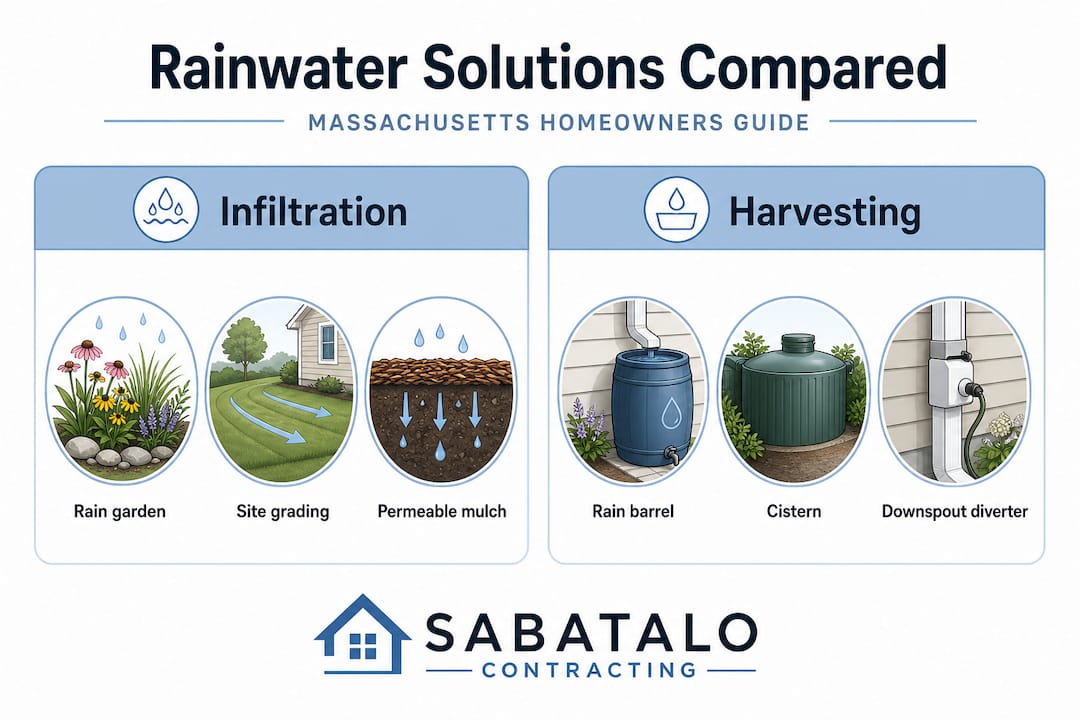
Understanding the importance of managing runoff is one thing. Knowing which solution fits your specific property is another. Massachusetts homeowners have several practical options, and the best choice depends on whether your main goal is stopping runoff from causing damage, storing water for later use, or both.
Infiltration-based solutions work by slowing water down and letting it soak into the ground naturally. Rain gardens are shallow, planted depressions that collect runoff from downspouts or paved areas. Bioswales are vegetated channels that move and filter water while encouraging infiltration. Permeable pavers replace solid concrete or asphalt with materials that allow water to pass through to the soil below.
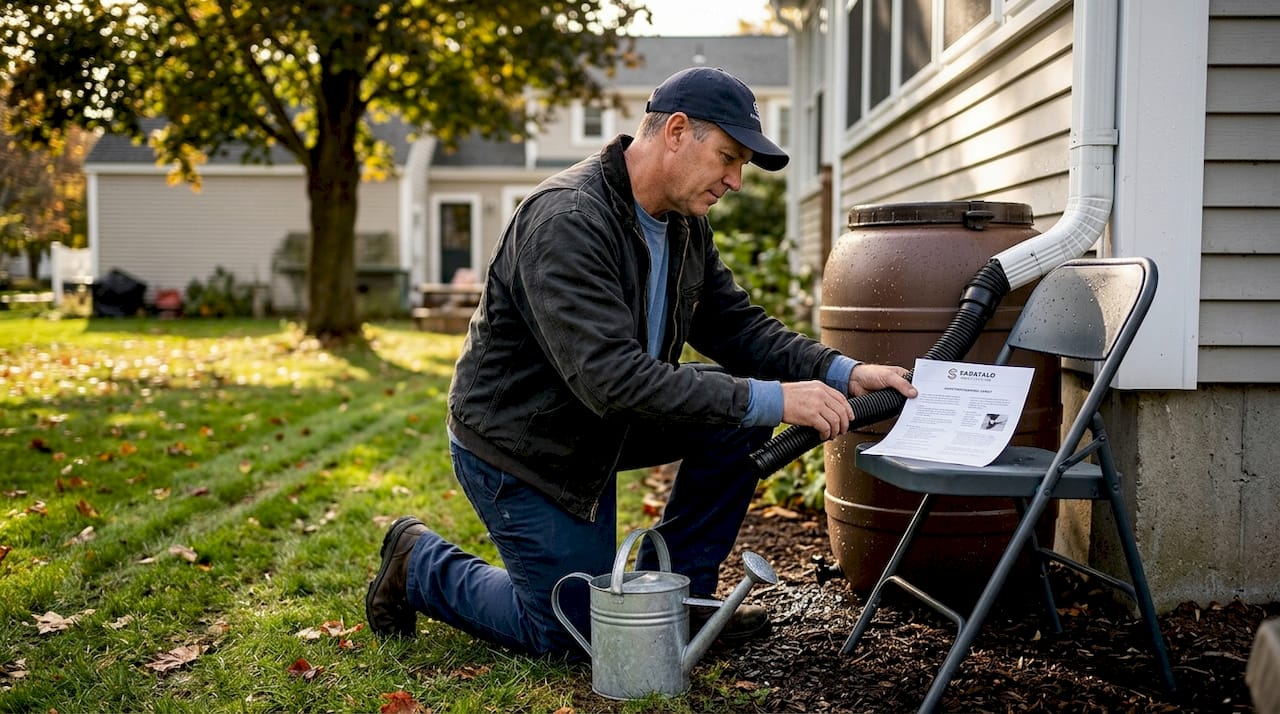
Rainwater harvesting uses barrels or cisterns connected to your downspouts to capture roof runoff before it hits the ground. That stored water is then used for irrigation, car washing, or other non-potable outdoor uses, reducing your reliance on municipal water during dry months.
Site grading and foundation protection involve reshaping the ground around your home so that water naturally flows away from the foundation rather than pooling against it. This is often the most overlooked but most critical fix for homes with persistent wet-basement problems.
Here’s a quick comparison to help you choose:
| Solution | Best for | Typical cost | Installation difficulty |
|---|---|---|---|
| Rain barrel | Water storage, bill reduction | $50 to $150 | Easy, DIY-friendly |
| Rain garden | Runoff absorption, landscaping | $500 to $3,000+ | Moderate |
| Bioswale | Large runoff channels, filtering | $1,000 to $5,000+ | Moderate to hard |
| Permeable pavers | Driveway/patio runoff | $10 to $30 per sq ft | Hard, requires base prep |
| Site regrading | Foundation protection | $500 to $5,000+ | Hard, needs professional |
Pro Tip: Match the system to your actual problem. If you have a wet basement, regrading and a rain garden near the downspout are your priorities. If you want to cut your summer water bill, start with rain barrels. Trying to solve both at once with one solution rarely works as well as layering two targeted approaches.
One thing that also matters is your roof. A roof that sheds water too quickly or has drainage issues makes every other system work harder. Looking into storm-resilient roofing or addressing potential issues like ice dams by reading up on how to prevent roof ice dams will also protect the effectiveness of your rainwater management systems over time.
Design and installation: Getting the most from rain gardens and barrels
Choosing the right solution is only half the work. Getting the design and installation right is what separates a system that functions well for decades from one that creates new problems.
For rain gardens, start with a soil infiltration test before you break any ground. UMass Amherst recommends a simple homeowner test: dig a hole about eight inches deep, fill it with water, and measure how fast the water level drops. You’re looking for at least one inch per hour. If your soil drains slower than that, you’ll need to amend it with a sandy loam mix or adjust the depth and overflow design of the garden.
Here’s a straightforward installation sequence:
- Test your soil for infiltration rate before committing to a location.
- Choose a spot at least 10 feet from your foundation and away from utilities.
- Calculate the garden size based on the square footage of the area draining into it. A rough rule is 20 to 30 percent of the contributing drainage area.
- Excavate 6 to 12 inches and replace with an amended soil mix if needed.
- Shape a berm on the downhill edge to hold water during storms.
- Plant with natives like swamp milkweed, blue flag iris, or cardinal flower that tolerate both wet and dry conditions.
- Add mulch to suppress weeds and retain moisture between storms.
For rain barrels, the process is simpler but still needs some attention. Connect the barrel to a downspout using a diverter kit, position it on a stable, level surface elevated at least a foot off the ground (this improves water pressure), and make sure the overflow outlet directs excess water away from your foundation.
One great local resource: Boston’s Office of Green Infrastructure gives away 300 free rain barrels each year and notes that barrels reduce localized flooding by capturing roof and gutter runoff before it hits the ground. Many Massachusetts towns run similar programs, so check with your local DPW before buying a barrel at retail.
For useful related reading across multiple home maintenance topics, the Sabatalo blog covers exterior upgrades and maintenance subjects specific to Massachusetts homes. And for more detailed guidance on testing your water quality before using harvested rainwater on a vegetable garden, this water quality testing guidance resource is worth reviewing.
Pro Tip: Always test soil infiltration rates before building a rain garden. Skipping this step is the most common reason rain gardens fail or flood neighboring areas instead of absorbing water on-site.
Legal, safety, and best practices for using harvested rainwater
Even the best-designed system needs to fit within legal boundaries and basic safety standards. Massachusetts homeowners are in a generally favorable position compared to some other states.
There are no specific statutory restrictions on residential rainwater harvesting for non-potable uses in Massachusetts. You can freely use rain barrels and cisterns to collect roof runoff for watering your lawn, washing your car, or irrigating your garden without any permits or approvals.
However, if you’re considering using harvested rainwater indoors, even for toilet flushing or laundry, you enter the territory of Massachusetts Title 5 and 314 CMR regulations, which govern reclaimed water systems. These require engineering review, permitting, and compliance with treatment standards. Most homeowners have no reason to go this route, but it’s worth knowing the line exists.
On the safety side, keep these practices in mind:
- Never connect a rain barrel to your home’s drinking water supply under any circumstances
- Keep barrels covered to prevent mosquito breeding, which is a real concern in Massachusetts during summer
- Label barrels clearly as non-potable water
- Do not use untested rainwater directly on root vegetables or leafy greens that will be eaten without cooking
- Clean gutters regularly because harvested rainwater may contain pathogens and contaminants from roof surfaces, bird droppings, and organic debris
If you want to use rainwater on edible plants, this rainwater safety testing resource provides a practical overview of what to test for and how to interpret results.
For a broader look at the regulatory context that affects exterior home improvements in Massachusetts, the Massachusetts roofing regulations guide covers related permit and compliance topics that intersect with drainage and roof improvements.
Advanced design and performance: Sizing, modeling, and site-specific considerations
For most Massachusetts homeowners, a single rain barrel or a modest rain garden handles the bulk of their stormwater challenge. But for larger properties, persistent problem areas, or homes in low-lying flood-prone neighborhoods, more detailed planning pays off significantly.
Hydraulic modeling tools like HydroCAD allow designers and experienced homeowners to simulate how rain gardens, bioswales, and other systems will perform under different storm intensities. Towns like Ipswich, MA, have made HydroCAD instruction guides publicly available, reflecting how seriously municipalities take localized stormwater management. If your project involves drainage across a large area or needs to meet local stormwater management requirements, this kind of modeling eliminates expensive guesswork.
Site-specific risks worth evaluating before installing any advanced system include:
- Poor soil infiltration (below 0.5 inches per hour) requiring engineered underdrain systems
- Proximity to septic systems, which complicates where you can discharge infiltrated water
- Contaminant pathways from driveways or areas where motor oil and road salt concentrate
- Slope and soil instability that may require professional regrading before any green infrastructure works
It’s also worth noting that rain garden performance can be affected by contaminant loading from urban runoff, and dissolved constituents like chloride from road salt can still move through a rain garden and reach groundwater. This is a particularly relevant concern for Massachusetts homeowners near roadways that receive heavy winter salting. Choosing plant species tolerant of salt and designing overflow paths carefully mitigates much of this risk.
Pro Tip: For any project that involves engineered drainage, significant grading, or proximity to a wetland or floodplain, consult a local contractor or civil engineer who knows Massachusetts permitting requirements before you start digging.
What most homeowners miss about effective rainwater management
After years of working on Massachusetts properties, here’s what we’ve observed: most homeowners either do nothing, or they buy a rain barrel, connect it to a downspout, and consider the job done. Neither approach captures the real opportunity.
The honest truth is that a single rain barrel, while genuinely useful, has a fixed capacity of 50 to 75 gallons. A typical suburban roof can shed over 600 gallons from just one inch of rain. The math reveals that one barrel alone is a start, not a solution. Yet marketing often oversimplifies this, leaving homeowners surprised when their basement still takes on water after a major storm.
The properties we see handle Massachusetts weather best are the ones where multiple systems work together. Regrading moves water away from the foundation. A rain garden absorbs the first heavy flush from the downspouts. A barrel captures moderate rainfall for summer use. And good gutters keep the whole system functioning cleanly. None of these is magic alone; layered together, they create a property that’s genuinely resilient.
The other thing most guides skip entirely is ongoing maintenance. A rain garden that isn’t weeded and mulched each spring fills with invasive plants and loses its infiltration capacity within a few seasons. A barrel that isn’t emptied or cleaned annually becomes a mosquito habitat and can clog its own diverter. Green infrastructure requires stewardship, not just installation.
This connects directly to the broader flood-proofing wisdom that drives smart exterior improvements: the best investment is one you maintain. A well-tended system protects your property year after year and increases in value as your landscaping matures.
Upgrade your home’s value and sustainability with expert support
Taking control of your property’s stormwater situation is one of the smartest investments a Massachusetts homeowner can make, and you don’t have to figure it all out on your own.

At Sabatalo Contracting & Home Improvement, we bring over 15 years of Massachusetts-specific expertise to exterior projects that protect, beautify, and add value to your home. From gutters and roofing to grading and drainage-aware exterior upgrades, our team understands how local climate and soil conditions affect your home’s performance. If you’re ready to explore how the right exterior improvements can help you manage rainwater while increasing your home’s appeal, visit our home exterior services page to see the full range of what we offer. You can also read more about strategies to increase home value through smart exterior upgrades tailored to the Massachusetts market.
Frequently asked questions
Are rain barrels legal for homeowners in Massachusetts?
Yes, there are no statewide restrictions on residential rain barrel use for non-potable purposes like irrigation and gardening, making them a straightforward starting point for most Massachusetts homeowners.
How much can rain barrels reduce my water bill?
Some Massachusetts households save up to 40% on summer outdoor water costs by using rain barrels for irrigation and other non-potable uses throughout the dry season.
How do I know if my soil is suitable for a rain garden?
UMass Amherst recommends a homeowner test where you fill an 8-inch hole with water and check that the level drops at least one inch per hour; slower drainage means you need to amend the soil or redesign the garden with an underdrain.
Is harvested rainwater safe for watering edible plants?
For most ornamental plants, untreated rainwater is fine, but rainwater may contain pathogens that make testing advisable before using it directly on leafy greens, root vegetables, or other crops consumed raw.
What maintenance do rain gardens and barrels need?
Rain gardens need seasonal weeding, debris removal, and mulch refreshing each spring to maintain healthy infiltration rates; rain barrels should be emptied before winter, covered during the mosquito season, and inspected annually for clogs or cracks.
Recommended
- Flood Proofing Your Home: Essential Steps for Massachusetts | Sabatalo Contracting
- Ice Dams on Roofs Prevention Guide for Homeowners | Sabatalo Contracting
- Storm Roofing Company: Protecting Massachusetts Homes | Sabatalo Contracting
- Roof moss removal guide 2026: protect your Massachusetts home | Sabatalo Contracting
